

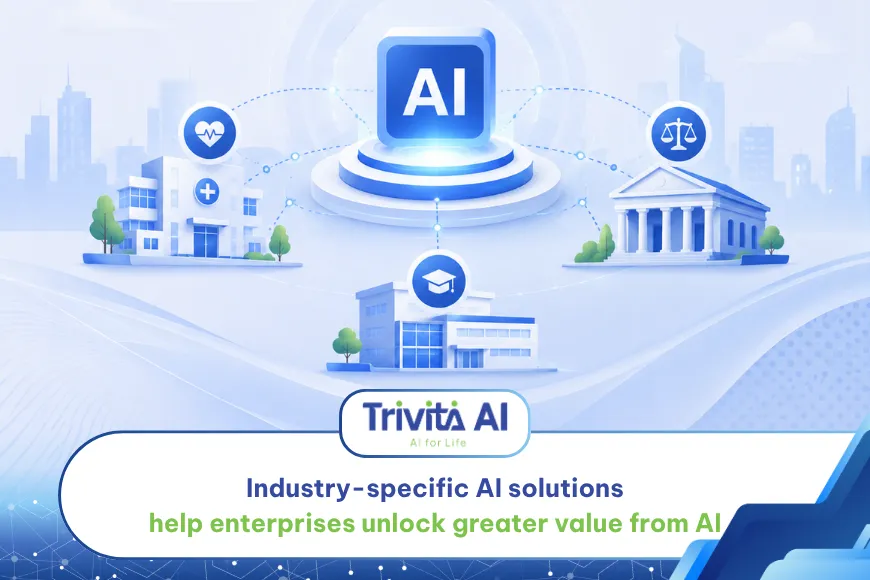
Discover how industry-specific AI solutions enable organizations to leverage enterprise data, optimize workflows and deploy AI tailored to the unique requirements of each industry.
AI is being adopted across almost every industry, from manufacturing and finance to healthcare, education and legal services. However, each sector has its own data structures, operational workflows and governance requirements. As a result, an AI solution that performs well in manufacturing may not be suitable for a healthcare organization or a legal services provider.
In practice, the value of AI depends not only on the underlying technology but also on its ability to adapt to industry-specific requirements. This is why industry-specific AI solutions are attracting growing interest from enterprises. Rather than applying a generic AI model to every business problem, organizations can deploy AI that aligns closely with real operational needs, leverages existing enterprise data and delivers business value more quickly.
Why do enterprises need industry-specific AI solutions?
Every industry has unique data and business processes
Every sector organizes data differently, follows unique workflows and relies on specialized terminology. Hospitals manage electronic medical records, clinical guidelines and patient care processes. Legal organizations work with legislation, contracts and case files. Manufacturing companies focus on production lines, inventory and operational performance.
These differences make it difficult for a single AI model to meet the needs of every industry. If an AI platform is not designed to understand industry-specific characteristics, its ability to analyze information, retrieve knowledge and support decision-making will be significantly limited.
AI delivers value only when it understands business context
AI cannot create meaningful value without business context. The same question may require completely different responses depending on the industry.
For example, the term “record” carries very different meanings in insurance companies, hospitals and law firms. An industry-specific AI solution must understand this context to retrieve accurate information, support the appropriate business workflow and generate relevant results for each domain.
This is also why more organizations are choosing industry-specific AI Platforms instead of relying solely on general-purpose AI tools.
Faster implementation and better return on investment
One of the biggest advantages of industry-specific AI solutions is their ability to shorten implementation time. Since the platform is already designed around industry requirements, organizations do not have to start from scratch or spend significant time adapting business processes.
This reduces implementation costs, accelerates AI adoption and enables organizations to realize business value sooner. At the same time, enterprises can more easily expand AI into additional use cases as business needs evolve.
What should an industry-specific AI solution provide?
Compatibility with industry-specific data
Data is the foundation of every AI system. Therefore, an effective AI solution must be capable of processing, managing and utilizing the types of data specific to a particular industry.
This not only improves analytical quality but also reduces the effort required for data preparation during implementation.
Support for specialized business workflows
Beyond data, an AI platform should align with the operational processes of the organization. From information intake and document processing to approval workflows and records management, AI should support existing business operations rather than forcing organizations to redesign the way they work.
Integration with existing enterprise systems
Most organizations already rely on enterprise software such as ERP, CRM, HRM and industry-specific management systems. Therefore, a Vertical AI Platform should integrate seamlessly with these existing systems, enabling organizations to leverage existing data without rebuilding their technology infrastructure.
Strong integration capabilities also ensure that AI becomes part of day-to-day business operations instead of functioning as an isolated application.
Scalability as business needs evolve
Enterprise AI requirements naturally evolve over time. Organizations may initially deploy AI for knowledge search or workflow automation before expanding into data analytics, decision support or domain-specific AI assistants.
An industry-specific AI Platform should be flexible enough to grow alongside the organization without requiring a complete redesign of the underlying system.

Which industries are best suited for industry-specific AI Platforms?
Healthcare
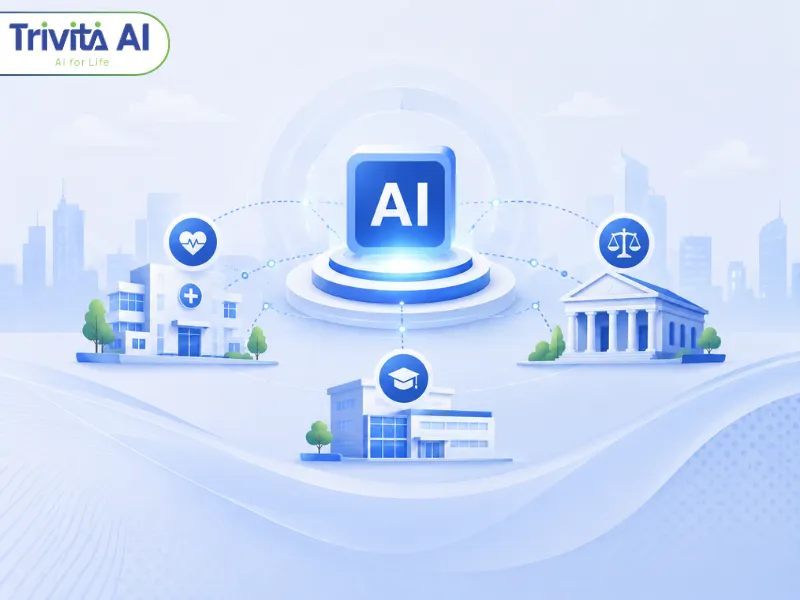
Healthcare organizations manage enormous volumes of specialized data while operating highly regulated and accuracy-critical workflows. Industry-specific AI Platforms can support medical knowledge management, accelerate information retrieval, assist clinical professionals and leverage healthcare data for both patient care and operational management.
Legal services
Within the legal sector, AI can assist with legal research, regulatory document retrieval, case law analysis and document management. When deployed on an industry-specific platform, AI enables lawyers and legal professionals to access relevant information more efficiently while maintaining the appropriate legal context.
Education
In education, AI can support knowledge management, personalize learning experiences and assist educators in preparing instructional materials or evaluating learning outcomes. Industry-specific AI solutions allow educational institutions to adopt AI in ways that directly support their educational objectives rather than simply adding another technology tool.
Manufacturing and service industries
For manufacturing and service organizations, AI Platforms can support process standardization, operational data analysis, performance optimization and decision support. Deploying AI on an industry-specific platform enables organizations to improve operational efficiency while leveraging their existing technology investments.
In practice, the industry is moving away from general-purpose AI platforms toward specialized AI ecosystems. This direction is increasingly being adopted by organizations seeking to solve industry-specific challenges across healthcare, legal services, education and many other sectors.
There is no single AI solution for every industry
Every organization has unique data, business processes and strategic objectives. Consequently, each requires an AI approach tailored to its specific context.
Rather than choosing the platform with the largest number of features, organizations should prioritize solutions that adapt to their industry’s unique requirements, integrate seamlessly with existing systems and provide the flexibility to scale as business needs evolve.
If your organization is planning its AI adoption strategy, working with an experienced provider of industry-specific AI Platforms such as Trivita AI can help assess business requirements accurately and develop an implementation roadmap that supports sustainable digital transformation.
