

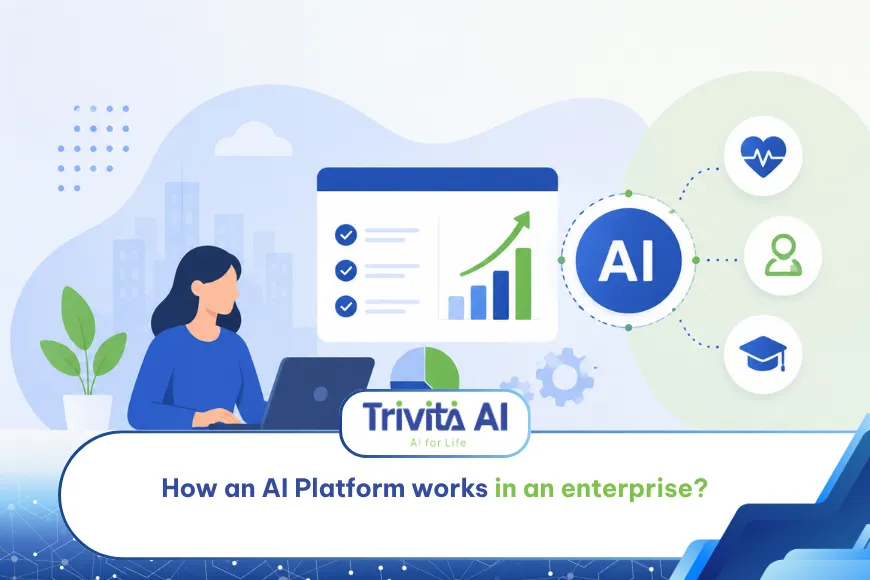
Learn how an AI Platform works by combining data, AI models and technology infrastructure to build, deploy and manage AI applications on a unified platform.
Understanding how an AI Platform works helps organizations do more than simply understand the underlying technology. It also provides the foundation for evaluating the right solution, building an effective AI adoption roadmap and avoiding investments driven by trends rather than actual business needs.
How does an AI Platform work?
Before exploring how an AI Platform works, it is important to understand that it is not a standalone AI application. Instead, it is a platform designed to build, deploy and manage multiple AI applications. An AI Platform acts as a central hub that connects enterprise data, AI models and existing business systems, enabling organizations to adopt AI through a unified strategy rather than deploying isolated tools.
Collecting and connecting data
Data is the foundation of every effective AI system. The first step of an AI Platform is therefore to collect and connect data from multiple sources, including ERP, CRM, HRM, internal databases, enterprise documents and external platforms.
By consolidating data on a unified platform, organizations can reduce data silos across departments while creating a consistent data foundation for AI models. This is also essential for AI applications to generate accurate and reliable results.
Processing and standardizing data
Once data has been connected, the AI Platform supports data cleansing, standardization and organization before it is used by AI models.
In practice, enterprise data often exists in multiple formats and may contain inconsistencies or duplicate information. Without proper standardization, AI models struggle to produce reliable outputs. For this reason, data processing is a critical stage in how an AI Platform works, improving analytical quality while reducing errors throughout operations.
Running AI models
After the data has been prepared, the AI Platform connects with AI models to address different business challenges.
Depending on business requirements, the platform may utilize multiple AI models for tasks such as data analytics, knowledge retrieval, content generation, information classification and decision support. Rather than relying on a single model, an AI Platform enables organizations to select, orchestrate and manage multiple AI models within the same environment, providing greater flexibility for AI adoption.
Managing and deploying AI applications
Beyond operating AI models, an AI Platform also enables organizations to deploy, monitor and manage all AI applications running across the enterprise.
Through a unified platform, organizations can measure application performance, control user access, update AI models and expand into new AI use cases without rebuilding the underlying infrastructure. This is a key distinction between an AI Platform and standalone AI tools, which are typically designed to solve only a single business problem.
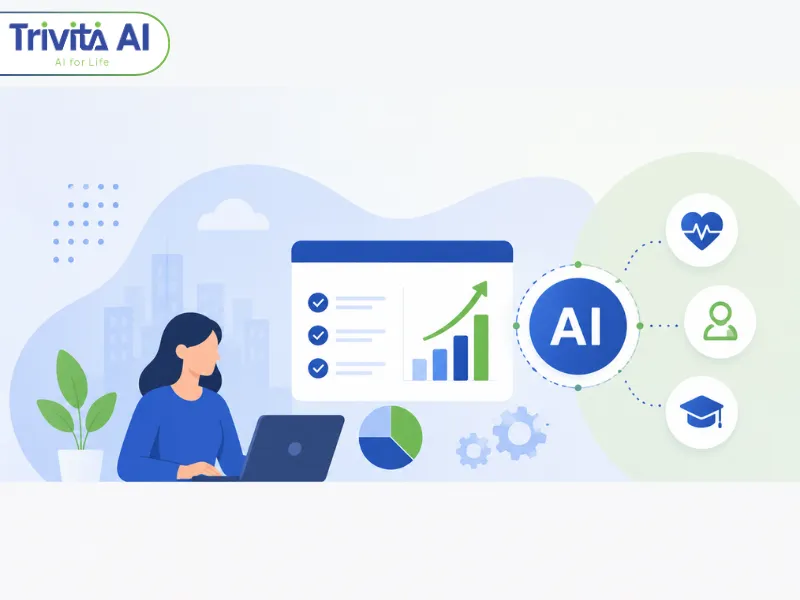
What are the typical components of an AI Platform architecture?
Although every AI Platform has its own architectural design, most platforms are built around four core layers. Understanding these components helps organizations gain a clearer picture of how an AI Platform operates without requiring deep technical expertise.
Data layer
The data layer is responsible for ingesting, storing and managing information from multiple enterprise data sources. It ensures that data is organized consistently and provides the foundation required for AI models to operate effectively.
AI model layer
This layer processes enterprise data and performs AI-related tasks. Depending on business objectives, organizations can connect multiple AI models to solve different use cases instead of relying on a single model.
Orchestration and integration layer
The orchestration layer connects enterprise data, AI models and existing business systems.
It enables the AI Platform to integrate with applications such as ERP, CRM and HRM while coordinating data flows between different systems.
Application layer
The application layer is where end users interact directly with the AI Platform through AI-powered solutions such as AI assistants, data analytics tools, enterprise knowledge search systems and workflow automation applications.
Ultimately, the business value of an AI Platform is delivered through this application layer.
Why should enterprises understand how an AI Platform works?
Understanding how an AI Platform works enables organizations to evaluate solutions based on real business requirements rather than marketing features alone. By understanding how the platform operates, organizations gain insight into how data is processed, how AI models are managed and whether the platform can integrate with existing enterprise systems.
This understanding also helps organizations avoid investing in AI simply because it is a market trend. Instead of selecting technology for its novelty, enterprises can build an AI adoption roadmap aligned with their business strategy, optimize investment resources and gradually expand AI applications over time.
In addition, understanding how an AI Platform works enables organizations to collaborate more effectively with implementation partners. When both parties share a common understanding of business objectives, enterprise data and operational requirements, implementation becomes smoother and delivers more sustainable value.

Where should enterprises begin when exploring AI Platforms?
An AI Platform is far more than a collection of AI models. It is a unified platform that connects enterprise data, technology infrastructure and AI applications to enable scalable and effective AI deployment.
Understanding how an AI Platform works helps organizations evaluate solutions more accurately, develop AI adoption strategies aligned with business objectives and make better-informed technology investment decisions.
If your organization is looking for an AI Platform that addresses real business requirements while supporting long-term digital transformation, Trivita AI is ready to help define an implementation roadmap tailored to your current capabilities and future strategic goals.
