

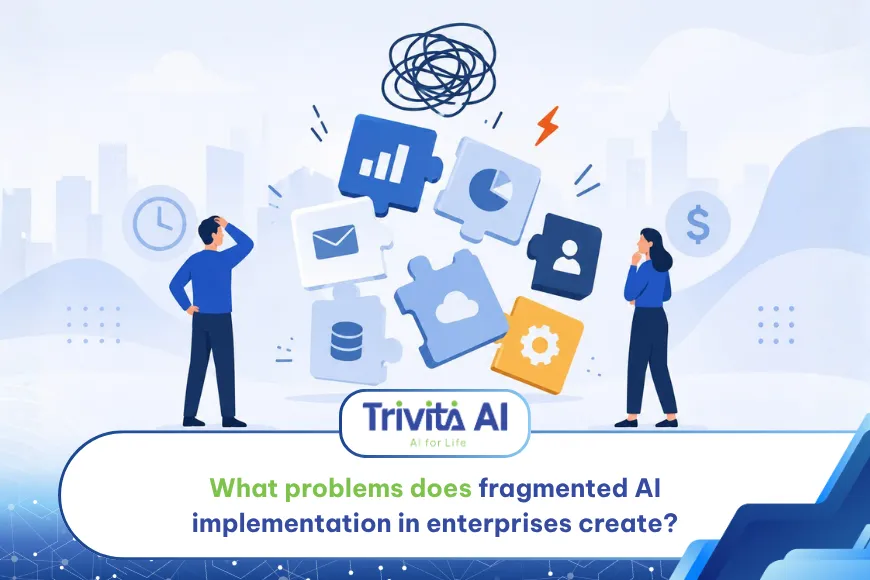
Discover how fragmented AI implementation in enterprises leads to data silos, disconnected workflows and reduced returns on AI investments.
After adopting AI for customer service, content generation, data analytics and workflow automation, many organizations eventually realize that their AI tools are operating independently, with little coordination and limited ability to generate value across the entire enterprise. Each department may have its own AI solution, but data is not shared, workflows remain disconnected and AI management becomes increasingly complex.
This situation, known as fragmented AI implementation, is one of the most common barriers preventing organizations from realizing the full potential of AI. Understanding the root causes of this problem helps enterprises develop a unified AI strategy and establish a strong foundation for sustainable digital transformation.
What is fragmented AI implementation in enterprises?
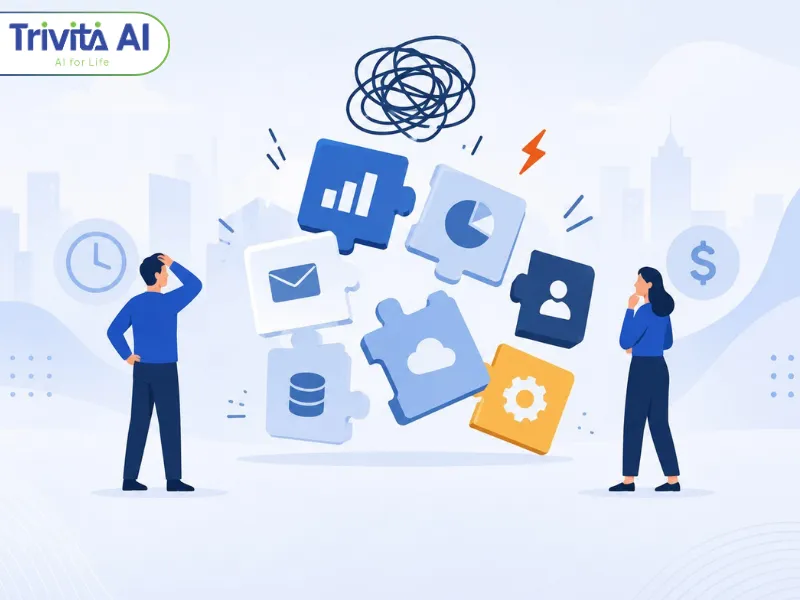
Fragmented AI implementation refers to a situation in which an organization uses multiple AI tools that operate independently, without sharing data or being managed through a unified platform.
In practice, each department may adopt different AI solutions to address its own needs. The Marketing team uses AI for content creation, the Sales department applies AI for customer analytics, while Human Resources deploys AI for recruitment and employee training. Although each solution delivers value individually, the lack of integration between data and business processes prevents the organization from fully leveraging AI across the enterprise.
It is important to note that fragmented AI implementation does not simply mean using multiple AI tools. The core issue is that AI applications, enterprise data and operational workflows are not connected, resulting in an isolated AI ecosystem with limited collaboration across the organization.
Why do organizations experience fragmented AI adoption?
Deploying AI to solve isolated business needs
In the early stages of AI adoption, organizations typically implement AI to address the immediate needs of individual departments. Each business unit selects the solution that best supports its own operations without considering integration with other enterprise systems.
Although this approach enables rapid deployment, it often results in multiple AI platforms operating independently, increasing fragmentation across the organization.
Lack of an enterprise-wide AI strategy
Many organizations approach AI as a series of short-term projects rather than a long-term strategic initiative. Without clearly defining objectives, implementation scope and development roadmaps, AI investments tend to become isolated efforts with limited collaboration across departments.
As a result, AI addresses individual tasks instead of supporting enterprise-wide operations.
Enterprise data remains distributed across multiple systems
Organizations often rely on ERP, CRM, HRM, document management systems and various industry-specific platforms simultaneously. If these data sources are not connected, each AI application can access only a limited portion of enterprise information.
When data remains fragmented, AI cannot generate comprehensive insights or support decision-making based on a complete organizational view.
No unified AI management platform
Another common cause is the absence of a centralized platform for managing AI across the enterprise.
When AI applications operate independently, managing users, controlling permissions, governing enterprise data and expanding AI capabilities becomes significantly more complex. This is also one reason why many organizations struggle to scale AI initiatives successfully.
How does fragmented AI affect organizations?
Limited ability to unlock value from enterprise data
Data is one of the most valuable assets for AI. However, when information is scattered across multiple disconnected systems, organizations struggle to establish a unified data foundation for analytics and decision support.
Consequently, AI applications process only isolated pieces of information rather than leveraging the organization’s complete knowledge base.
Disrupted business workflows
Business processes typically involve collaboration across multiple departments. When each department uses a different AI tool that cannot exchange data or coordinate workflows, operational processes become fragmented.
Employees are forced to switch between multiple platforms, manually re-enter information or verify data repeatedly, reducing productivity while increasing the likelihood of operational errors.
Higher investment with limited business returns
Deploying multiple standalone AI solutions often requires organizations to invest in multiple platforms, separate training programs and independent management processes.
However, the business value generated does not increase proportionally because these systems cannot collaborate effectively toward shared organizational objectives.
Difficulty expanding AI adoption
When organizations seek to introduce additional AI use cases, disconnected AI systems become a major obstacle. Every new initiative requires additional data integration, workflow redesign and connections to multiple existing systems.
As a result, scaling AI becomes significantly more time-consuming, expensive and resource-intensive than expanding from a unified enterprise AI architecture.

Signs that an organization is experiencing fragmented AI implementation
Many organizations recognize the problem only after the number of AI tools continues to grow while overall business performance remains unchanged. Marketing operates one AI platform, Sales uses another and Human Resources deploys yet another solution. Each department becomes more efficient individually, yet data is rarely shared across systems.
Another indicator is inconsistent AI-generated results because each platform relies on different data sources. Whenever enterprise-wide reporting or consolidated analysis is required, employees still need to manually reconcile information across systems.
AI governance also becomes increasingly complicated as access permissions, security policies and operational procedures are managed separately for each application. Furthermore, whenever a new business challenge arises, the organization deploys another AI solution instead of extending its existing AI infrastructure.
If these situations occur frequently, they are strong indicators that the organization is facing fragmented and disconnected AI implementation.
A unified AI strategy is the foundation for long-term value
The value of AI is determined not by the number of AI tools an organization owns, but by how effectively enterprise systems, data and business processes are connected to work together.
A unified AI strategy enables organizations to utilize enterprise data more effectively, reduce fragmentation across departments and establish a scalable foundation for future AI expansion.
If your organization is experiencing fragmented AI implementation, evaluating your current AI landscape and building a unified AI architecture with Trivita AI can be an important step toward maximizing AI investments and developing sustainable AI capabilities.
