

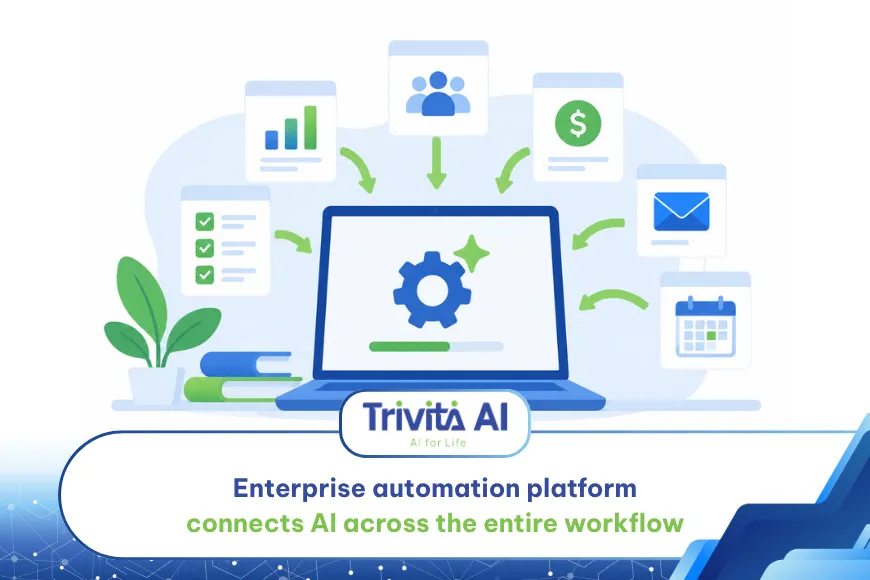
An enterprise automation platform connects AI, data and workflows, helping organizations reduce fragmentation and build scalable automation capabilities.
Enterprise automation often begins with specific tasks. Software may transfer data between two systems, an AI tool may support document processing, or a department may build a workflow to reduce repetitive activities. Each solution can improve part of the work, but it does not necessarily make the entire operating process more seamless.
As the number of applications increases, enterprises may face a paradox: many tasks have been automated, yet people are still responsible for connecting them. Data moves across multiple systems, departmental workflows operate independently, and a change in one process may require adjustments across several tools.
This is where an enterprise automation platform needs to be viewed as more than a tool for performing automated tasks. The platform provides a foundation for organizing workflows and connecting data, systems and AI capabilities so that automation can evolve from isolated points into part of the enterprise’s broader operating capabilities.
Fragmented automation does not create a seamless process
A task may be automated while the process containing that task still depends on multiple manual steps. For example, an AI system may process input information, but an employee still needs to retrieve the output, review it, transfer it to another application and notify the next department. Technology has shortened one step, but the overall flow of work remains interrupted.
The problem becomes more apparent when each department independently selects its own tools. Marketing may have one automation system, operations may build another workflow, while specialized departments continue adding AI applications for their own requirements. The enterprise then has multiple points of automation without the ability to organize them into a connected system.
Fragmentation also makes scaling more complex. When a new requirement emerges, the enterprise may need to configure data connections, permissions, processing logic and integrations with existing systems all over again.
The value of automation should therefore not be measured solely by the number of tasks that no longer require manual intervention. More importantly, enterprises need to consider whether those tasks are part of a seamless workflow and whether the output of one stage can become the appropriate input for the next.
AI workflows bring technology into the entire flow of work
AI workflows for enterprises extend the role of AI from a single task to a sequence of interconnected activities. AI systems can participate at appropriate stages, data can move according to defined logic, and people can remain involved at points that require review or decision-making.
An AI Workflow Platform for enterprises therefore requires more than AI capabilities. Its value also lies in connecting those capabilities with data, systems and business logic.
Data needs to move according to workflow logic
A workflow typically uses information from multiple sources. If users constantly need to search for, copy and transfer data between systems, these manual points will limit the degree of automation that can be achieved across the entire process.
When data is connected to the workflow, the system can deliver the right information to the appropriate processing stage. The output of one step can also move forward to support the next instead of always requiring a person to act as the intermediary.
However, connecting data does not mean that every system should have access to all information. An enterprise automation platform still needs to ensure that data is used within boundaries appropriate to users, business requirements and enterprise governance.
AI needs to be placed at the right steps rather than every step
Not every activity requires AI technology. Some steps can be handled through conventional automation logic, others may benefit from AI-based information processing, while certain stages still require human expertise and judgment.
Workflow design therefore needs to begin with how work actually happens. Enterprises need to understand where delays occur, how data is used and what role each person plays in the process before deciding where AI technology should participate.
This approach positions AI as a component that supports the workflow rather than making AI itself the objective of the workflow. Automation is designed to improve how work operates, not to introduce AI into as many stages as possible.
A shared platform allows automation to build on existing capabilities
When every workflow is developed as a separate system, enterprises may repeatedly need to solve the same problems. Different teams may all need to connect data, use AI capabilities, manage users or interact with existing business software, yet implement these requirements in different ways.
A Business Automation Platform provides a different approach. Capabilities that can be shared are organized into a common foundation, while individual workflows continue to be designed according to the requirements of specific departments and business functions.
As a result, automation does not require every process to be standardized into a single model. An internal information-processing workflow may be very different from a process in healthcare, legal services or education. The reusable elements exist at the technology capability layer, while business logic still needs to be specialized.
This also creates a foundation for enterprises to scale automation more systematically. When a new workflow is introduced, the organization can determine which components already exist and can be reused rather than always starting again with a new collection of tools.
An Intelligent Automation Platform therefore creates value not only by performing more automated actions. Its value also comes from combining data, AI capabilities and workflows so that existing capabilities can continue to be reused and developed as requirements evolve.
AI Agents expand automation capabilities but still need to operate within workflows
The development of AI Agents introduces a new approach to automation. Instead of responding only to individual requests, an Agent can be designed to perform multi-step tasks, use tools or interact with other components within a system.
An enterprise automation platform integrated with AI Agents can therefore extend workflow capabilities. However, introducing Agents does not mean that enterprises should move entire processes toward fully autonomous AI operation.
Agents need clearly defined objectives and operating boundaries
An Agent creates value only when its responsibilities are clearly defined. It needs to understand the objective it is expected to achieve, which information sources it can access, which tools it is allowed to use and under what conditions control should be transferred to a person.
Without these boundaries, an Agent’s ability to perform multiple steps can make workflows more difficult to control. Enterprises therefore need to design Agents as components within a system rather than as entities operating independently from the process.
The platform provides an environment in which Agents can connect to the necessary capabilities while operating within clearly defined boundaries.
People need to remain involved at appropriate decision points
A workflow involving Agents may still require people to review results, approve actions or handle situations outside the designed scope. The level of human involvement depends on the type of work and the requirements of each enterprise.
This becomes particularly important in highly specialized business functions. AI systems can support search, synthesis and information processing, but their outputs do not automatically replace professional judgment.
The appropriate direction is therefore not to remove people from workflows, but to redesign how people, AI systems and enterprise technology work together. Agents handle suitable activities, while people remain responsible for stages that require expertise, accountability and decision-making.
Trivita AI approaches automation from shared platforms to specialized domains
Trivita AI approaches AI development by starting with real-world problems, data and operating contexts. Rather than treating automation as simply adding another tool to a process, this approach considers AI technology in relation to the systems, workflows and people directly involved in the work.
At the platform layer, capabilities related to natural language processing, computer vision, machine learning, data and AI infrastructure provide a foundation for developing specialized applications. When reusable capabilities are organized appropriately, new use cases do not necessarily need to be built as completely independent systems.
At the application layer, workflows need to adapt to individual domains. Healthcare processes have different requirements from legal workflows, while education involves its own users, data and objectives. A shared platform therefore needs to support specialization rather than applying the same automation model across every environment.
This direction is reflected in the Trivita AI ecosystem, with MedVita for healthcare currently being deployed, LawVita for legal services under development, and EduVita representing Trivita AI’s direction for education. These branches share the same direction for developing AI capabilities while continuing to be built around the specific characteristics of each domain.
From this perspective, AI systems, workflows and Agents are not the final objective. Technology needs to be organized to support a better flow of work, reduce unnecessary manual activities and provide people with stronger capabilities for processing information as part of their work.
Enterprise automation needs to connect technology with how people work
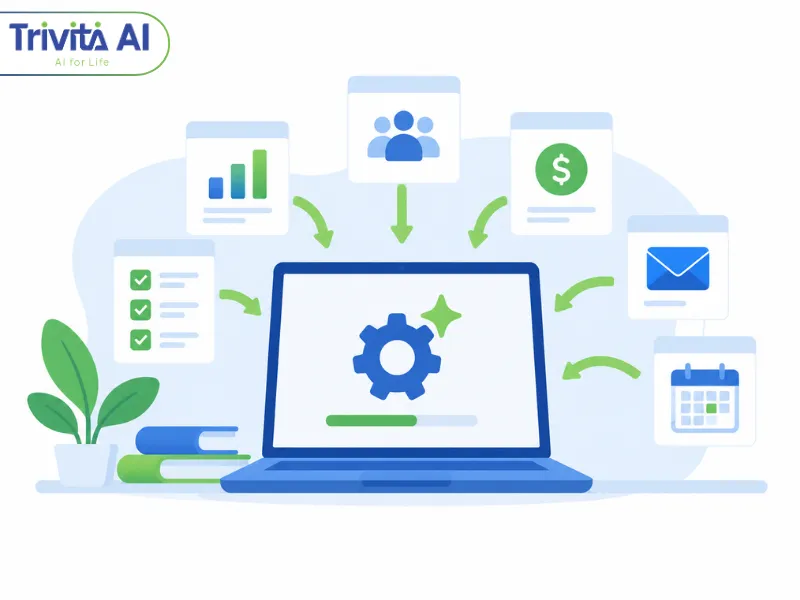
An enterprise automation platform creates value when it helps organizations move from isolated automation tools and tasks toward workflows that connect data, systems, AI capabilities and people within the same flow of work.
When reusable capabilities are organized into a shared foundation, enterprises can develop additional workflows and gradually introduce Agents into appropriate tasks without necessarily creating a separate system for every new requirement.
With a human-centered approach, Trivita AI aims to connect core AI capabilities with specialized operating contexts. Automation is not intended to eliminate the role of people, but to ensure that technology handles the right parts of the work so that processes can operate more efficiently and continue evolving over the long term.
