
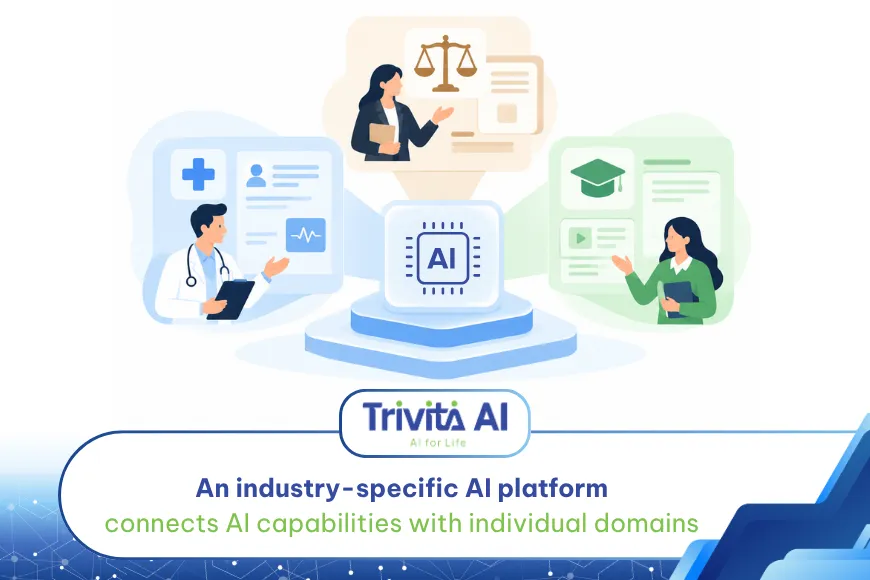
An industry-specific AI platform combines AI capabilities with domain data, knowledge, and workflows to better address real-world needs.
AI can process language, images, and data while supporting many different types of work. These capabilities create a broadly applicable technology layer, but as AI moves deeper into healthcare, legal services, education, and other specialized business functions, general-purpose capabilities may no longer be sufficient.
Each industry has its own language, data, knowledge, and workflows. The same technology may be used very differently in healthcare compared with legal services. Users also need more than AI-generated outputs; they need those outputs to be relevant to the context of their work.
This is why an industry-specific AI platform has become an important approach. Rather than developing AI to address every problem in the same way, the platform combines reusable technology capabilities with the data, knowledge, and workflows of each domain, bringing AI closer to real-world environments.
General-purpose AI is not enough for specialized business functions
A general-purpose AI platform can provide core capabilities such as language processing, data analysis, and image understanding. These capabilities provide an important foundation for businesses to develop different applications without rebuilding the entire technology stack.
The gap emerges when these capabilities are applied directly to specialized business functions.
Users in different industries not only work with different data but also interpret and use information differently. A term used in a professional environment may carry a specific meaning that a system designed for general-purpose needs may not fully understand.
Workflows also differ. The way a doctor accesses information is different from how a legal professional or educator works. The role of AI, the points where people need to review outputs, and how results move to the next step all depend on the environment in which the technology is used.
The challenge, therefore, is not choosing between general-purpose AI and industry-specific AI. Businesses need to determine which capabilities can be developed as shared components and which need to be specialized so that the technology fits each domain.
This provides the foundation for an industry-specific AI Platform approach.
The platform needs to understand the domain before the task
A Domain AI Platform is not simply an AI platform with additional industry data. The domain also includes specialized knowledge, how users work, existing systems, and requirements related to how information is used.
The specialization process therefore needs to begin with understanding the industry before determining which tasks AI should perform.
The problem needs to be defined from the business function
A common approach to AI implementation is to begin with what the technology can do and then search for places where it can be applied. This may generate many ideas for using AI without necessarily addressing the problems that actually affect day-to-day work.
An industry-specific AI Platform needs to take the opposite approach. Businesses first identify the problem, users, data, and workflow, and then select the appropriate AI capabilities.
This approach helps distinguish between steps that can genuinely benefit from AI support and those that still require direct human expertise or judgment.
Users determine the role of AI
The same information-processing capability may need to support doctors, legal professionals, or educators in completely different ways. Platform design therefore cannot focus solely on the AI model.
Businesses need to determine where users will interact with AI, what type of information they need to receive, and what happens after an AI-generated output is produced.
When users become part of the design process, AI can be positioned within the workflow as a supporting capability rather than remaining a standalone tool outside the business function.
Understanding the domain helps define the right problem. But for AI to truly adapt to an industry, the platform also needs an appropriate layer of data and knowledge.
Data and knowledge create the industry-specific layer
An industry-specific AI platform needs to connect technology capabilities with information sources that accurately reflect the environment in which they will be used. This layer enables AI to move from general-purpose processing toward supporting a specific domain.
Data needs to match the context of use
Each industry generates different types of data. Healthcare has its own information systems and specialized documents, legal services work with specific documents and records, while education uses content and data related to teaching and learning processes.
Data used by AI therefore needs more than sufficient volume. More importantly, it needs to be relevant to the problem, appropriately organized, and used within the correct scope.
An industry-specific AI Platform needs to clearly determine which data sources support which applications. This helps provide AI systems with the appropriate context while avoiding the assumption that every application needs access to all available industry data.
Domain knowledge helps AI understand context more deeply
Data provides information, but expertise determines how that information should be understood and used.
This is why domain experts play an important role in developing industry-specific AI. They help define terminology, context, how outputs should be interpreted, and the situations in which human review is required.
Technology teams and domain experts should therefore not operate as two separate groups. One understands the capabilities and limitations of the technology, while the other understands the environment in which that technology will operate.
Combining these capabilities creates an industry-specific layer that a general-purpose AI platform cannot easily develop simply by adding more features.
However, understanding the right data and knowledge is still not enough. The platform also needs to bring these capabilities directly into the user’s flow of work.
Workflows bring AI into real-world operations
A system may understand extensive industry knowledge but still struggle to create practical value if users need to leave the software they are working in, manually find data, transfer it to an AI tool, and then move the results back into the process.
Domain-specific AI therefore needs to be designed together with the workflow.
AI needs to appear at the right step
Not every step in a process requires AI. Some steps may be handled effectively through software or conventional automation rules, while AI may be more appropriate for tasks involving large volumes of information, unstructured data, or helping users access knowledge.
Identifying the right position for AI helps businesses avoid introducing the technology into workflows simply to increase the level of AI adoption.
An industry-specific AI platform needs to enable data to reach the right step, allow AI to perform the appropriate task, and then deliver the output to the relevant person or system.
People remain part of the workflow
Specializing AI does not mean handing over an entire business function to technology. In domains that require professional expertise, AI needs to operate in relation to the people responsible for using its outputs.
There may be steps where AI supports information processing while people review the results, provide additional context, or make decisions. These control points need to be defined when the workflow is designed.
This approach aligns with human-centered AI: technology handles appropriate tasks so that people have better access to information and more time for work that requires expertise, reasoning, and accountability.
Once data, knowledge, and workflows have been specialized, the next challenge is developing multiple applications without rebuilding the entire technology stack for every use case.
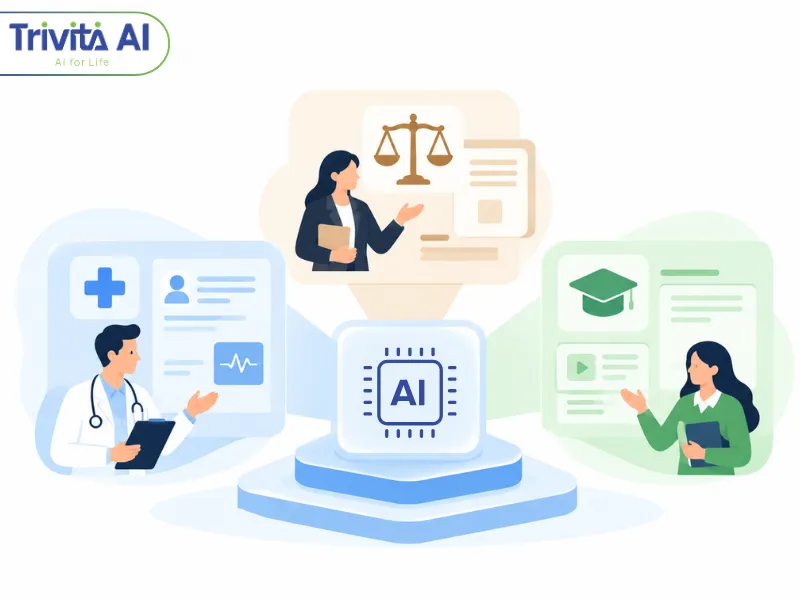
A Vertical AI Platform balances shared capabilities and specialization
A Vertical AI Platform creates a structure in which technology capabilities can be reused while components associated with each domain are developed separately. This enables the platform to scale while remaining relevant to the industry it serves.
At the foundation layer, capabilities related to language, computer vision, machine learning, data, and AI infrastructure can support multiple applications. Organizing these components as shared capabilities allows new use cases to build on what already exists instead of always starting from the beginning.
At the industry-specific layer, data, knowledge, workflows, and user experiences are developed for each domain. This is where a Domain AI Platform differs from introducing an unchanged general-purpose AI tool into a professional environment.
This two-layer structure also addresses a common tradeoff. If every application is developed completely independently, businesses struggle to reuse technology capabilities. But if everything is standardized on a single shared platform, AI may not provide sufficient depth for specialized business functions.
An industry-specific platform needs to sit between these two approaches: what can be shared is organized into the platform, while what determines relevance to the domain is specialized.
Trivita AI approaches AI development in this way. Core technology capabilities form the foundation, while applications are developed around the problems and specific characteristics of each industry.
This direction is reflected in the ecosystem with MedVita for healthcare, which is currently being deployed; VitaLaw for the legal sector, which is under development; and EdVita as the direction for education. These three domains can reuse appropriate AI capabilities but cannot be approached through an identical implementation model.
What connects these different branches is not a single AI solution applied unchanged across every industry. Instead, technology capabilities are developed as a shared foundation and then combined with the data, knowledge, and workflows of each domain to support people within their specific contexts.
An industry-specific AI platform needs to be shared enough to scale and specialized enough to create value
An industry-specific AI platform creates a bridge between two seemingly competing requirements: businesses need reusable AI capabilities so they do not have to continuously rebuild technology from the beginning, while each industry requires sufficiently specialized data, knowledge, and workflows for AI to genuinely fit its business functions.
A Vertical AI Platform addresses this challenge by organizing technology capabilities into a shared foundation and developing the domain layer around each context of use. This brings AI closer to real-world work while keeping people at the center. It is also the approach behind Trivita AI’s development of MedVita, VitaLaw, and EdVita, where technology provides the foundation and the ultimate value emerges when AI understands the industry and supports the right human needs.
