

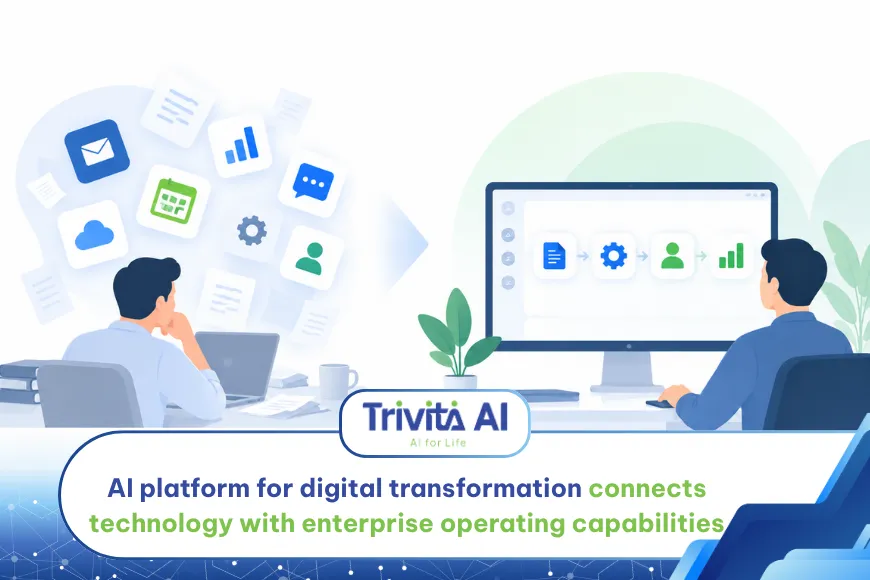
An AI platform for digital transformation connects data, systems and workflows, helping enterprises build AI capabilities that can integrate and evolve over time.
Digital transformation in enterprises often begins from multiple starting points. One process is digitized, a new management system is deployed, or a department begins using AI technology to process information. Over time, enterprises accumulate more technologies, but those components do not necessarily become a unified capability.
The emergence of AI makes this challenge even more apparent. AI systems can support data analysis, knowledge retrieval, document processing and partial workflow automation, but if each application operates independently, enterprises may continue adding fragmented layers of technology.
An AI platform for digital transformation should therefore be viewed as more than another AI tool. Its role is to create a shared capability layer that connects technology with data, systems, workflows and people, allowing AI to become an evolving part of the enterprise transformation journey.
Digital transformation needs to move from digitizing tasks to building capabilities
Digitizing a document, moving a process into software or using AI technology for a specific task can all be part of digital transformation. However, if these activities remain isolated, an enterprise may own many digital tools without achieving a corresponding improvement in how the organization operates as a whole.
The difference lies in connectivity. Can data generated by one system be used in another process? Can departments access shared technological capabilities? Can a new application build on what the enterprise has already developed, or does every initiative need to begin again from the start?
These questions become even more important when AI is added to the environment. A standalone AI tool may quickly address a specific need but may not help the enterprise build capabilities that can be used more broadly. If every department continues selecting and operating AI independently, digital transformation risks creating additional points of fragmentation.
AI technology supports digital transformation more effectively when it becomes part of the operating system rather than appearing only within individual tasks. Enterprises therefore need to develop not only more applications, but also the ability to organize digital capabilities so they can connect, be reused and continue to scale.
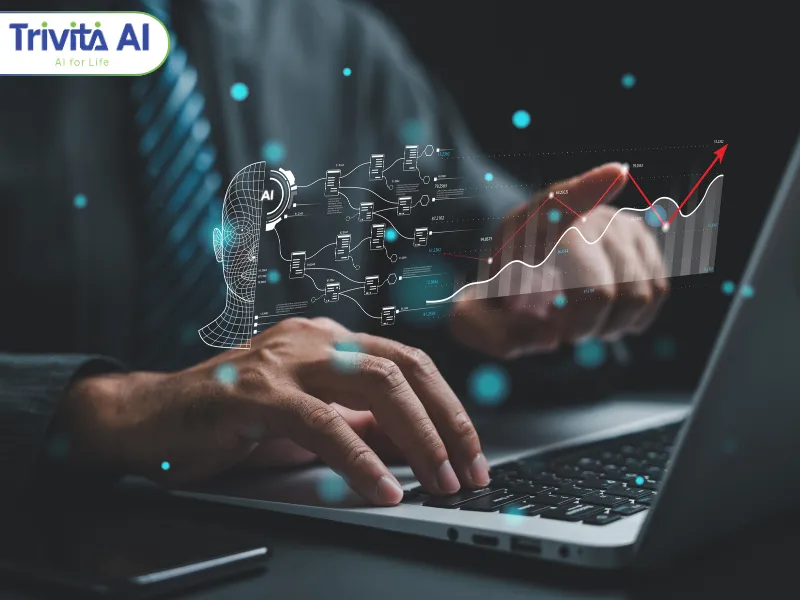
An AI Platform connects enterprise data, systems and workflows
AI systems do not operate independently from the rest of the enterprise. To produce relevant results, the technology needs access to the right data, must participate at the appropriate points in workflows and should be able to interact with existing systems.
This is one of the key roles of an AI platform for digital transformation. Instead of requiring each application to solve integration challenges independently, the platform provides a foundation for organizing technological components within an architecture that allows them to work together.
Data needs to become an accessible and well-governed resource
Enterprises usually possess substantial amounts of data before implementing AI. Information may reside in business software, documents, databases or systems developed at different stages of the organization’s technology journey.
If every AI application connects to data differently, scaling becomes increasingly complex. Enterprises not only need to maintain multiple integrations but also need to manage access permissions and determine how information is used across individual systems.
An Enterprise AI Platform enables organizations to approach data in a more structured way. This does not mean centralizing all data in one place or allowing every application to access the same information. Instead, it provides a foundation for determining which data sources should serve which requirements and within what boundaries.
AI needs to participate directly in the flow of work
The value of AI technology is also limited if its outputs cannot continue through the business process. Users may receive a summary or analysis from an AI system but still need to manually transfer the information into the next system.
An integrated AI Platform shifts the perspective from automating individual tasks to connecting AI with the flow of work. The output of one stage can become the appropriate input for the next, while people remain involved at points that require evaluation, review or decision-making.
In this way, AI does not sit alongside digital transformation but becomes part of how the operating environment functions.
A shared platform allows AI applications to inherit and scale capabilities
When enterprises begin with only a few AI applications, developing each solution independently may not create significant problems. However, as requirements spread across multiple departments, this approach can result in many AI systems that coexist without being able to work together effectively.
Each project may need to resolve infrastructure, data, integration and user management challenges again. Capabilities developed for one application may not necessarily be reusable in the next.
An Enterprise AI Platform creates a capability layer that can be inherited. Appropriate components can be organized for use across multiple applications, while higher-level functions continue to be developed according to the specific requirements of individual departments.
This does not mean an enterprise needs a single application for every department. Digital transformation takes place across different business contexts, so specialization remains necessary. The important point is that specialized applications do not need to become completely isolated systems.
The ability to inherit existing capabilities also enables enterprises to approach AI expansion with a longer-term perspective. When a new problem emerges, the organization can evaluate which capabilities already exist, which components can be reused and what still needs to be developed. AI capabilities can therefore accumulate over time instead of repeatedly becoming separate projects.
AI-driven digital transformation still needs to begin with people and real-world problems
Owning a technology platform does not automatically create transformation. If an enterprise has not clearly identified the problem it needs to solve, an AI Platform can become a large technology layer without sufficiently defined use cases.
Enterprise AI solutions should therefore begin with the problem. Organizations need to understand where workflows contain bottlenecks, where users need support, which data is relevant and whether AI technology is genuinely appropriate for the task.
This approach also helps avoid the assumption that AI-driven digital transformation means automating as much as possible. In some processes, AI systems can handle repetitive activities or support information retrieval. In other stages, people still need to apply expertise, experience and accountability when evaluating results.
This becomes particularly important in domains with highly specialized requirements. Healthcare, legal services and education each involve different data, workflows and decision-making processes. A shared platform can provide technological capabilities, but the applications built on top still need to be developed according to the requirements of each environment.
Human-centered digital transformation therefore does not begin by asking how many jobs AI can replace. A more relevant question is where technology can help people access information, perform work and make better decisions.
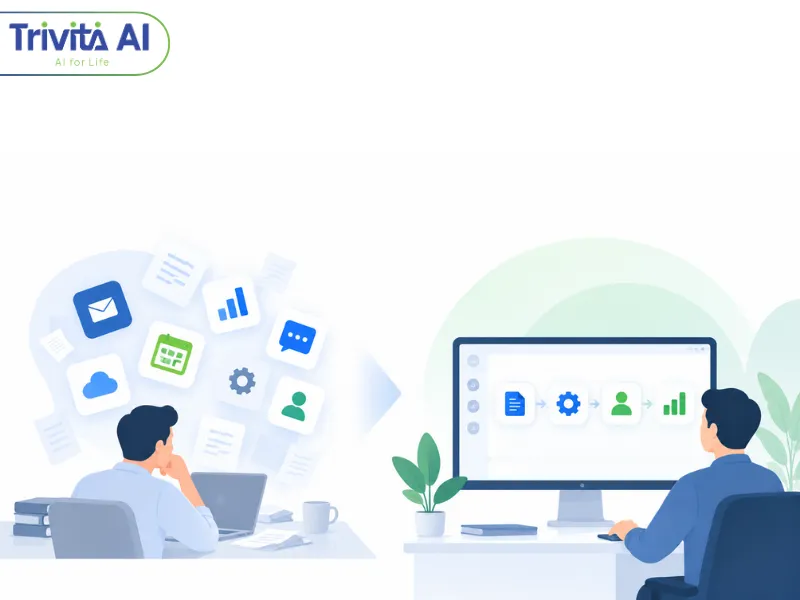
Trivita AI connects platform capabilities with individual application domains
Trivita AI approaches AI development from real-world problems and industry context rather than beginning by applying the same technology across every environment. The process focuses on understanding the industry, analyzing the problem, building an appropriate platform, deploying it and continuing to develop it based on actual usage requirements.
At the technology layer, Trivita AI develops capabilities in natural language processing, computer vision, machine learning, data and AI infrastructure. These core capabilities provide a foundation that applications can inherit from a technology perspective rather than treating every new problem as a completely new system.
At the application layer, the platform needs to be specialized for individual domains. Healthcare data, legal workflows and educational environments cannot be handled using the same logic simply because they all involve AI technology. Domain knowledge and the role of people need to be incorporated into the solution design process.
This direction is reflected in the Trivita AI ecosystem, with MedVita for healthcare currently being deployed, LawVita for legal services under development, and EduVita representing Trivita AI’s direction for education. Each branch addresses different requirements while following the same approach of connecting core AI capabilities with specific operating contexts.
With this structure, AI can become part of the digital transformation journey without being separated from systems, business operations and people. Technology serves as a supporting capability layer, while the ultimate value is still determined by how effectively the platform solves real-world problems.
An AI Platform creates value when it becomes part of digital transformation
An AI platform for digital transformation should not be viewed simply as another tool added to the existing technology environment. It should function as a capability layer that helps enterprises connect AI with data, workflows and applications already in operation.
When reusable capabilities are organized on a shared platform while individual solutions remain specialized for specific business requirements, enterprises gain a stronger foundation for reducing fragmentation and developing AI on top of what they have already built instead of repeatedly starting over with each new project.
With a human-centered approach to AI development, Trivita AI approaches digital transformation by applying technology to the right problems, connecting platform capabilities with individual domains and helping people use data, knowledge and workflows more effectively.
