

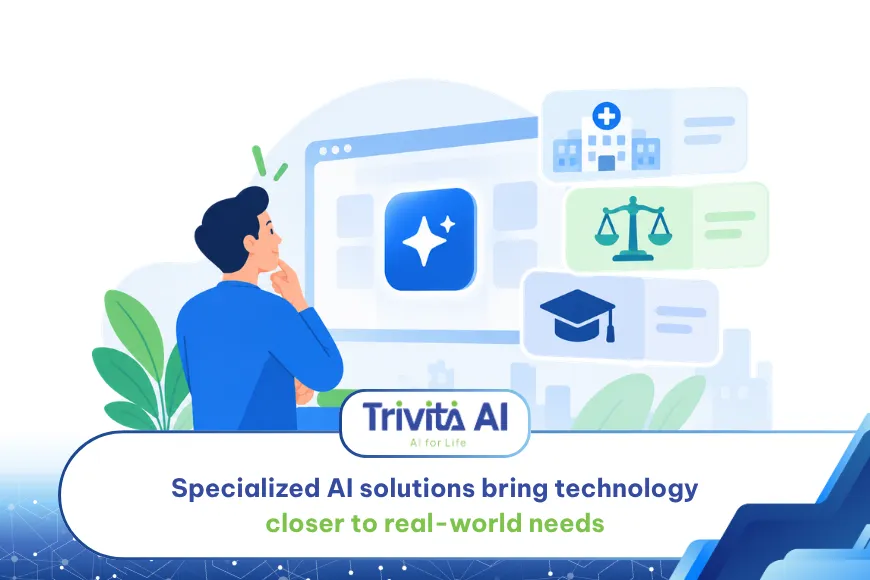
Specialized AI solutions combine technology with domain-specific data, knowledge and workflows to support practical AI adoption.
AI systems are increasingly capable of performing a wide range of tasks, from natural language processing and data analysis to information retrieval and synthesis. However, the ability to handle many types of tasks does not mean that a single AI tool can perform equally well across every operating environment.
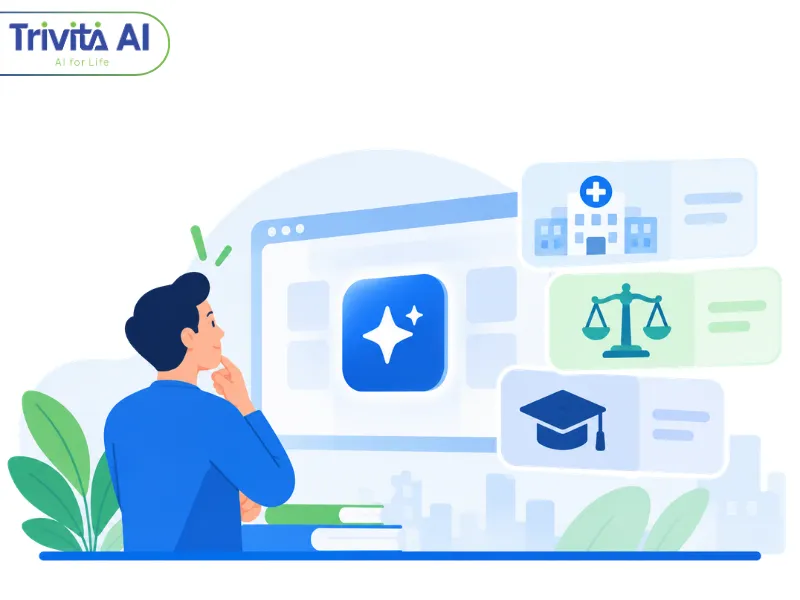
A hospital, a legal organization and an educational institution operate with entirely different data, knowledge, workflows and standards. As AI technology becomes more deeply integrated into these environments, general information-processing capabilities are no longer sufficient. AI systems need to operate within the right context to understand who they are supporting, what types of data they are working with and where they should participate in existing workflows.
This creates the foundation for the development of specialized AI solutions. Instead of applying the same tool across every industry, AI technology is developed around the specific characteristics of each domain and use case, bringing technological capabilities closer to real-world needs.
Specialized AI creates value through context
General-purpose AI tools offer significant advantages in accessibility and flexibility. Users can apply them to many everyday tasks without building dedicated systems. This approach is suitable when requirements are general and do not depend heavily on specialized professional workflows.
The difference becomes more apparent when AI systems begin to participate more deeply in organizational operations. A healthcare system needs more than natural language processing capabilities; it must operate within the context of medical data and terminology. AI applications for the legal sector need to work with a different body of knowledge, documents and professional logic. In education, users, content and application objectives introduce another set of specific requirements.
Therefore, industry-specific AI solutions are not simply existing tools supplemented with additional domain data. The value of specialization comes from connecting multiple elements so that AI technology is better aligned with the environment in which people actually use it.
This also demonstrates that general-purpose and specialized AI do not necessarily exclude one another. Each approach addresses a different level of need. When organizations require AI systems to work deeply with domain-specific data, knowledge and workflows, the degree of specialization becomes an important consideration.
4 layers that define AI solutions for specific industries
Specialized AI solutions are not defined by the name of an AI model or the number of features they provide. Their practical value depends on how technology is developed alongside data, knowledge, workflows and the specific requirements of each domain.
Data creates the foundation for adaptability
Every industry creates and uses data differently. Even within the same sector, organizations may have different data sources, structures, quality levels and purposes.
Industry-specific AI solutions therefore need to be developed in relation to real-world data environments. AI systems should not only be capable of receiving data but also be designed to use that data appropriately for the problem being addressed.
As data sources change or organizations expand their operations, the platform also needs to adapt. This is one of the factors that distinguishes customized AI solutions from tools configured in the same way for every organization.
Domain knowledge helps AI understand the right context
Access to large volumes of information enables AI systems to know more, but in professional environments, knowing more does not necessarily mean understanding correctly.
A term may carry a specific meaning within a particular industry. Information that is accurate in isolation may need to be interpreted differently when placed within a specific professional context. Domain knowledge therefore becomes an important layer in the development of specialized AI solutions.
The involvement of domain experts also plays a significant role. AI engineers provide the technical capabilities required to build the technology, while industry professionals help clarify context, workflows and the boundaries that need to be respected. Combining these perspectives enables AI systems to be developed in ways that more closely reflect how people actually work.
Workflows determine where AI should be applied
Not every step within a workflow requires AI. An effective solution needs to determine where technology should provide support rather than attempting to automate every activity that can technically be automated.
In some situations, AI systems can help synthesize large volumes of information or make knowledge more accessible to users. In other stages, professional experience, human judgment and accountability remain essential.
Positioning AI appropriately within workflows allows technology to augment human capabilities rather than adding unnecessary complexity. This is also an important principle of human-centered AI.
Industry standards shape how technology should be deployed
Every industry has different requirements for security, safety, accountability and data use. These requirements need to be considered during the design process rather than added only after the platform has been completed.
Particularly in environments involving sensitive data or professional decision-making, testing, validation and risk management should become integral parts of AI development.
Specialization therefore does more than help AI systems better understand an industry. It also places the technology within the appropriate boundaries and principles of the environment in which it will operate.
The value of specialized AI Platforms emerges through real-world application
When selecting AI solutions, enterprises can easily focus on what the technology is capable of demonstrating. However, a feature that performs well in a testing environment does not necessarily create the same value in real-world operations.
A specialized AI Platform needs to be evaluated based on its ability to address a problem throughout the entire application process. The technology should have a clearly defined starting point, be validated within the appropriate context and continue to evolve as organizational requirements change.
Start with the problem rather than the technology
An effective AI project should begin by identifying the problems users face, the relevant data, bottlenecks in existing workflows and the desired outcomes. Only then should the organization determine the role AI technology can play.
This approach reduces the risk of selecting a technology first and then searching for a problem to which it can be applied. It also helps organizations distinguish between needs that require specialized AI solutions and those that can be addressed effectively with general-purpose tools.
Validate before scaling deployment
AI systems can produce convincing results during testing, but real-world environments contain significantly more variables. Data may be inconsistent, user behavior may differ from expectations and new scenarios may emerge during operation.
Testing and validation therefore help organizations understand both the capabilities and limitations of a solution before expanding deployment. This is not simply a technical evaluation but also an assessment of how well the AI system fits its intended operating environment.
Evolve alongside the organization
An AI Platform should not be treated as a product that is completed once and remains unchanged. Organizational data, workflows and requirements can all evolve over time.
The ability to continuously adapt and develop allows the solution to remain relevant throughout its lifecycle. AI technology can then move beyond solving an immediate task and become part of the organization’s long-term technological capabilities.
Trivita AI builds specialized AI capabilities for different industries
Trivita AI focuses on developing specialized AI solutions based on the unique characteristics of each industry. Rather than treating a general-purpose AI model as a solution that can be applied unchanged across multiple domains, the approach begins with specific problems, data, domain knowledge, regulations and relevant professional standards.
The development process moves from understanding the industry and analyzing the problem to building the AI Platform, deploying it in real-world environments and continuously improving it. This places technology in direct relationship with people and the environments in which it is used rather than treating AI as an isolated layer of tools.
To support this direction, Trivita AI combines the capabilities of scientists, AI engineers and domain experts with expertise in natural language processing, computer vision, machine learning, data and AI infrastructure. Testing, validation, data security and risk management are also integrated into the solution development process.
MedVita develops specialized AI for healthcare
MedVita is Trivita AI’s healthcare-focused AI branch and is currently being deployed. Healthcare is an environment in which data, specialized knowledge, workflows and security requirements all have distinct characteristics.
Under Trivita AI’s approach, healthcare AI systems are designed to support people rather than replace doctors or healthcare professionals. Technology is applied to appropriate use cases to help people access and process information more effectively.
VitaLaw develops AI around legal knowledge
VitaLaw is Trivita AI’s AI branch for the legal sector and is currently under development. The terminology, documents, knowledge and professional logic of the legal domain create specific requirements for how AI systems should be developed.
This direction demonstrates how core AI capabilities need to be further developed according to industry context before they can become appropriate tools for supporting professionals.
EdVita focuses on specialized AI for education
EdVita represents Trivita AI’s direction for the education sector. In this environment, technology needs to be considered in relation to users, content, objectives and learning experiences rather than directly applying a design developed for another industry.
AI technology is intended to help people access knowledge and support more relevant learning experiences, while teachers and learners remain central to the educational process.
Specialized AI creates value when technology understands where it is used
The value of specialized AI solutions does not lie in creating an AI system that can do everything. It lies in connecting the right technological capabilities with the data, knowledge, workflows and requirements of the environment the technology is designed to serve.
When developed around real-world problems, tested in the appropriate context and continuously improved according to actual user needs, AI technology can become a long-term organizational capability rather than simply another standalone tool.
With a human-centered approach to AI development, Trivita AI is building the MedVita, VitaLaw and EdVita ecosystem on a shared foundation of core technological capabilities while specializing each platform for its respective domain. The objective is to develop AI systems that work alongside people, helping them access knowledge, perform their work more effectively and make better-informed decisions.
