

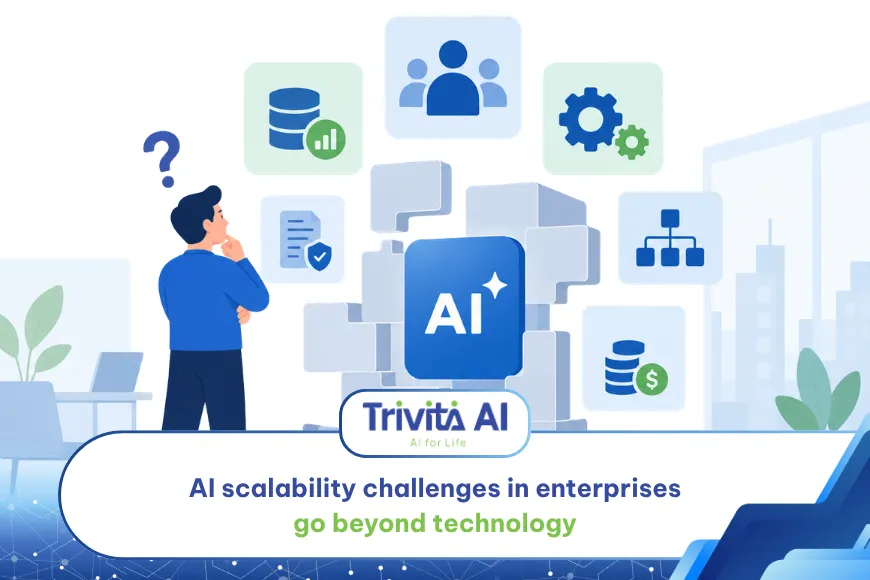
AI scalability challenges in enterprises arise when data, workflows and infrastructure are not ready to turn successful pilots into shared capabilities.
Many enterprises begin adopting AI technology to address a specific need. One department may experiment with a tool for document processing, another team may use an AI system to synthesize information, or a workflow may incorporate automation capabilities. At a small scale, these applications can demonstrate clear potential.
The challenge often emerges at the next stage. A solution that works well for one team may not be suitable for deployment across multiple departments. A successful pilot may not remain stable as the number of users and volume of data increase. This is where AI scalability challenges in enterprises begin to emerge, even when organizations already have experience using the technology and have seen its initial value.
The problem does not necessarily mean that AI technology is not powerful enough. Moving from experimentation to organization-wide deployment requires enterprises to address data, workflows, infrastructure, business requirements and people at the same time. AI therefore needs to be considered as part of a broader system rather than a tool that can be scaled simply by granting access to more users.
The gap between AI pilots and enterprise-scale adoption
An AI pilot typically takes place within a relatively controlled environment. The implementation team can select a clearly defined problem, work with a specific dataset and involve a limited number of users. These conditions allow enterprises to quickly evaluate the capabilities of the technology.
As deployment expands, those initial conditions begin to change. The number of users increases, data comes from more sources and AI systems need to interact with a wider range of workflows. Marketing requirements may differ from those of operations, while finance, human resources and specialized teams may have their own ways of using data and evaluating results.
This is where AI becomes difficult to scale if the initial solution was designed for a standalone task without considering how it would connect with a broader system. Replicating the same pilot across multiple departments is also unlikely to produce identical results because the context of use has changed.
Scalability therefore cannot be measured simply by the number of people who can access an AI system. A system may technically support more users without being truly scalable if every department still needs to establish its own usage methods, data processing practices and solutions to the same underlying problems.

AI becomes difficult to scale when data and workflows remain fragmented
One of the biggest differences between experimentation and enterprise-scale deployment lies in the complexity of data and workflows. When AI technology supports only a small team, the system may operate with a limited number of data sources and predefined working methods. As deployment expands, the number of variables increases significantly.
Unprepared data environments limit scalability
Enterprise data may be distributed across internal documents, business software, databases and multiple systems developed at different points in time. If every AI application needs to connect to and process data differently, complexity increases with every additional use case.
In this situation, AI scalability challenges in enterprises do not necessarily arise because the model cannot process more data. The underlying problem is that the enterprise data environment does not provide a shared foundation that enables multiple applications to access and use data appropriately. As organizations expand AI across departments, data access permissions, data sources and update mechanisms also need to be clearly defined.
Different workflows make it difficult to replicate the same solution
Every department has its own objectives and ways of working. Even when teams use the same AI capability, the way the technology participates in their workflows may differ.
A tool that helps one team synthesize information may not fit how another team reviews, uses and transfers that information. If a solution is designed too tightly around an initial workflow, significant modifications may be required every time the enterprise attempts to scale it.
Scaling AI therefore does not mean replicating the same usage model across the entire organization. Enterprises need to determine which technological capabilities can be shared and which components need to adapt to the specific business requirements of each department.
A shared platform reduces fragmentation as AI deployment expands
As demand for AI grows across departments, enterprises may reach a point where each team selects its own tools or develops its own implementation approach. This can address immediate needs during the early stages of adoption but often creates fragmentation as the number of applications increases.
Teams may repeatedly encounter the same challenges related to data integration, infrastructure, access permissions and workflow integration. The organization may eventually have many AI applications without developing shared AI capabilities that can be used and expanded across the enterprise.
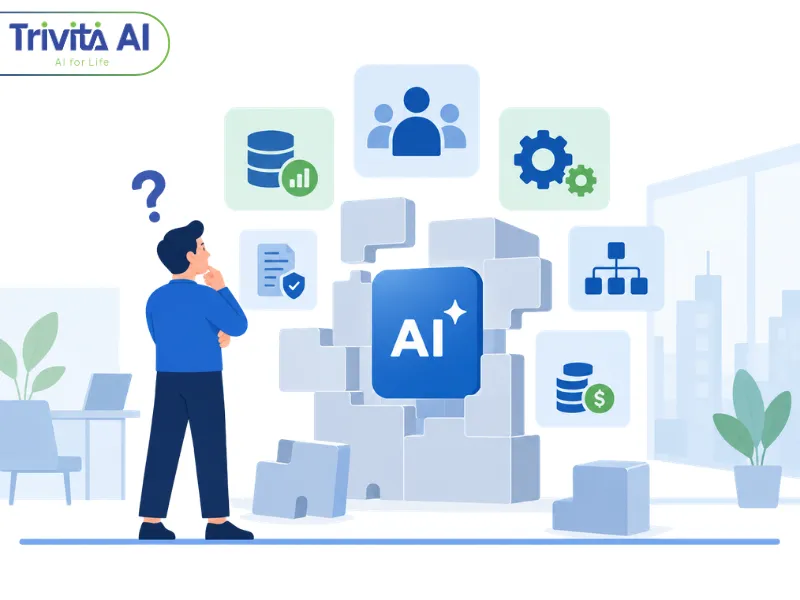
An Enterprise AI Platform provides a different approach. Core technological capabilities, relevant data and infrastructure can form a shared foundation, while individual applications are developed around the specific needs of different departments or domains.
This structure does not mean that every department needs to use AI technology in the same way. Its value lies in ensuring that reusable components do not need to be rebuilt for every use case, while business-specific elements can still be specialized where necessary.
Scalability should also be considered from the design stage. If a solution is built solely to address an immediate requirement, expanding it later may require substantial changes. A platform-based approach, by contrast, allows enterprises to identify early which capabilities can be shared, which data sources need to be connected and which components should remain customizable.
When a new use case emerges, the enterprise can build on the existing foundation rather than restarting the entire development process. This is one of the key conditions for moving AI beyond isolated pilots and establishing scalable capabilities across the organization.
People and business requirements determine how far AI can scale
A system may be technologically ready but still difficult to scale if it does not align with how people actually work. As the number of users increases, differences in requirements, user capabilities and responsibilities become more apparent.
An AI system deployed within a pilot group is typically used by people who understand the project’s objectives and are prepared to adapt to a new tool. When deployment expands across the organization, not every user will have the same level of understanding or use AI technology in the same way.
Enterprises therefore need to clearly define which parts of a workflow AI systems are intended to support and which still require human review, evaluation or decision-making. These principles become particularly important when AI technology participates in specialized professional workflows or processes sensitive data.
Scalability also depends on whether AI technology is genuinely suitable for each business context. A shared platform does not mean ignoring differences between departments. Instead, the common technology layer should enable specialized applications to be developed on top of the same foundation.
When people remain at the center of this process, the objective of scaling AI also changes. Enterprises do not need to introduce AI into as many activities as possible. Instead, they need to apply the technology where it can help people process information, access knowledge and work more effectively.
Trivita AI approaches scalability from shared foundations to specialized domains
Trivita AI approaches AI development by building shared platform capabilities while specializing applications for individual domains. Rather than treating a single general-purpose model as the answer to every requirement, the development process begins with understanding the industry, analyzing the problem, and examining the relevant data, domain knowledge and operating environment.
This approach helps distinguish between capabilities that can be shared and components that need to be developed for specific contexts. Core technologies can provide a common foundation, while real-world applications continue to adapt to the workflows, data and requirements of each domain.
This direction is reflected in the Trivita AI ecosystem, including MedVita for healthcare, which is currently being deployed; VitaLaw for the legal sector, which is under development; and EdVita as Trivita AI’s direction for education.
Scaling AI requires a strong platform foundation
AI scalability challenges in enterprises demonstrate that the gap between a successful pilot and an AI capability that can be widely used across an organization is not determined solely by the power of the underlying model. Enterprises also need to address fragmented data, differences in workflows, platform integration and how people use technology in real-world environments.
When reusable capabilities are organized into a shared foundation while specific requirements continue to be specialized for individual business functions, AI technology has a stronger basis for evolving from a tool used by one team into a capability that supports multiple departments.
This is also the direction Trivita AI follows by connecting core technological capabilities with specialized platforms, where AI systems work alongside people to support their work and decision-making.
