

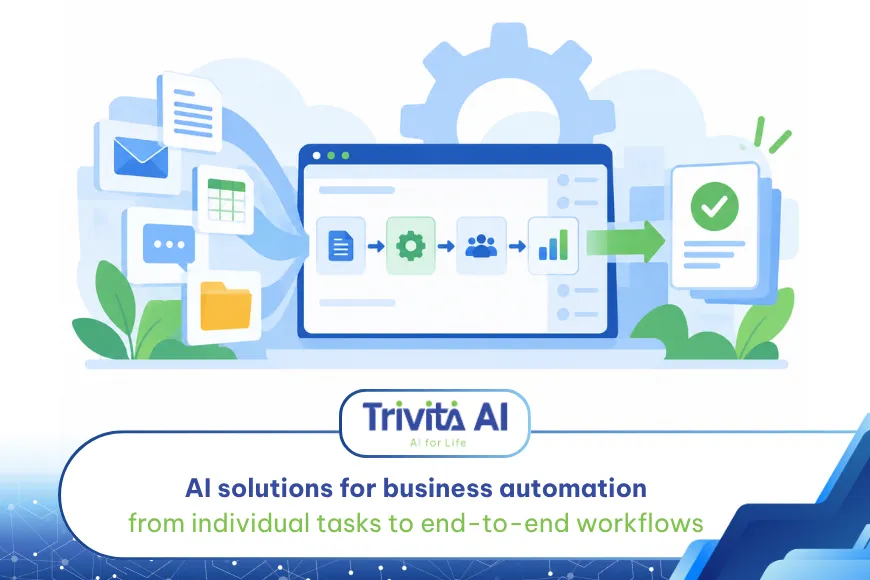
AI solutions for business automation connect data, workflows, and technology to reduce repetitive tasks and optimize business processes.
Automation is not a new concept for businesses. Software has long been used to handle tasks with clearly defined rules, transfer data between systems, and reduce manual work. The development of AI is now extending automation to tasks that involve language, documents, images, and large volumes of information.
As a result, businesses have more options for automation. One tool may support document processing, another system may summarize information, while AI technology can be introduced at specific stages of an operational process. However, if each application only addresses an isolated task, people still need to connect outputs across multiple tools.
Therefore, AI solutions for business automation should be viewed as more than a way to replace a few manual tasks. Their broader value lies in how AI technology connects with data, systems, and workflows to support the entire flow of work, while keeping people involved at points that require expertise, evaluation, and decision-making.
AI expands automation from rule-based tasks to information processing
Traditional automation is well suited to tasks with relatively clear inputs and processing rules. When condition A occurs, the system performs action B. This approach remains valuable, and not every process requires AI.
The difference emerges when businesses need to process inputs that are more difficult to standardize, such as text, documents, images, or requests expressed in natural language. AI systems can add the ability to process these types of information, expanding the scope of automation.
For example, instead of requiring people to read an entire set of documents before transferring relevant information to the next step, an AI system can support the extraction or summarization of relevant content. Technology can therefore participate in parts of the workflow that were previously difficult to handle using fixed rules alone.
However, business automation with AI does not mean that every task should be handled by an AI system. A step governed by simple rules may still be processed efficiently through conventional automation, while AI may be more appropriate for steps that involve extracting, interpreting, or processing information.
The question businesses need to answer is therefore not “How many tasks can AI perform?” but rather where AI should be introduced to improve the overall process.
AI-powered process automation needs to connect data and workflows
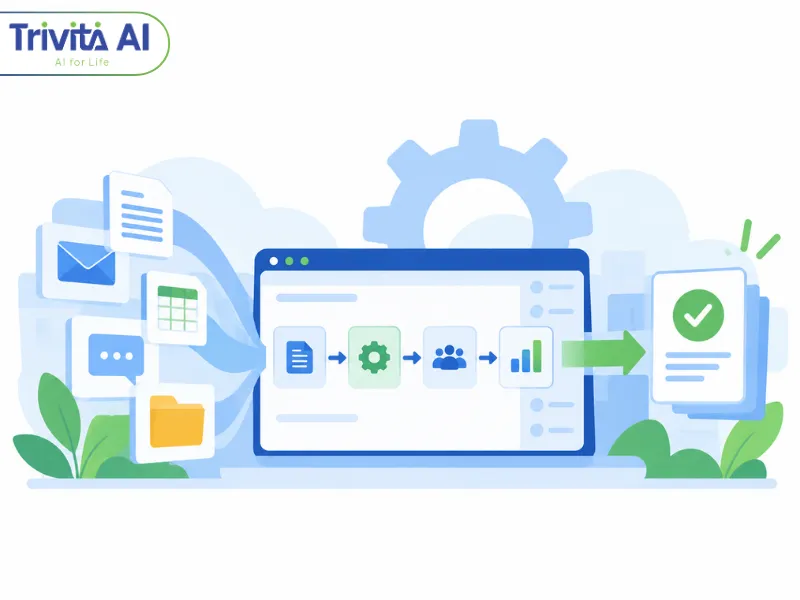
Automating a task does not mean that an entire process has been automated. Real-world work typically involves multiple interconnected steps, data from different sources, and participation from multiple people or systems.
If AI only operates at one point, its output may still need to be manually transferred to the next step. A business may reduce manual work in one area while creating gaps between different tools.
Data needs to move with the flow of work
AI systems need information to perform tasks. If data is distributed across documents, business software, or multiple databases, users may need to search for and transfer that data into a tool before the AI system can begin processing it.
An AI workflow solution needs to account for how data reaches each step. The output of one task can become the input for the next instead of requiring people to continuously copy or transfer information between systems.
This connectivity also needs to be supported by appropriate data management. Automation does not mean that every application should have access to all information. Data access permissions still need to be defined according to users and business contexts.
Workflows need to clearly define the roles of AI and people
A workflow may include steps that are fully automated, steps supported by AI, and steps that require human involvement. Clearly distinguishing these roles helps businesses avoid introducing AI where it is unnecessary.
AI systems can support information synthesis or handle certain repetitive tasks, while people review outputs and make decisions at appropriate points. The workflow can therefore be designed around how work actually happens rather than around the objective of eliminating as many human actions as possible.
This provides an important foundation for keeping AI-powered automation practical when deployed at enterprise scale.
An AI automation platform enables multiple workflows to build on shared capabilities
When a business is automating only a few processes, separate tools may adequately address its needs. However, as the number of workflows increases, fragmented implementation begins to create new challenges.
Each department may choose a different system, connect to data in its own way, and use separate AI capabilities. When a new workflow is introduced, the business may once again need to address similar challenges involving integration, data, and infrastructure.
An AI automation platform provides a different approach by organizing capabilities that can be shared. AI, data, and relevant technology components can form a common foundation on which multiple workflows can be developed.
This does not mean that every process needs to be the same. Operations teams work differently from human resources, while specialized business functions have their own data and requirements. A shared platform enables reuse at the technology layer, while the workflows built on top can still be designed around individual problems.
An AI Automation Platform therefore does more than help businesses create additional automated workflows. Its value also lies in reducing the likelihood that every new requirement will result in another completely independent system.
When a new workflow emerges, businesses can assess which capabilities already exist and which components genuinely need further development. Automation can then become an accumulating organizational capability rather than a collection of isolated projects.
Automation effectiveness should be measured by improvements across the entire process
One way businesses can misjudge the effectiveness of AI is by focusing only on the time required to complete an individual task. A particular step may become significantly faster, but the overall process may not improve if users need to spend additional time reviewing outputs, transferring data, or resolving errors at later stages.
AI-powered process optimization needs to be evaluated more broadly. Businesses should examine the workflow from end to end, identify where bottlenecks occur, and assess how AI changes the experience of the people performing the work.
This becomes particularly important when automation involves functions that require professional expertise. AI systems can help process large volumes of information, but their outputs do not automatically replace the judgment of domain experts.
People therefore remain an essential part of automation design. A well-designed workflow should help users reduce unnecessary tasks, access information more conveniently, and focus more of their time on work that requires reasoning, experience, or accountability.
This perspective also helps businesses avoid treating the level of automation as an objective in itself. A process is not necessarily better simply because it involves fewer people. The real value lies in assigning technology and people to the parts of the workflow where each can contribute most effectively.
When AI is positioned appropriately, automation can become a way to reorganize work rather than simply replace individual actions. This is an important step in moving from the use of individual AI tools toward building AI-supported operational capabilities.
Trivita AI approaches automation from the problem and context of use
Trivita AI approaches AI development by starting with the problem, data, and environment in which the technology will be used. Rather than introducing AI into a process simply because the technology can perform a particular task, the role of AI should be determined by the real-world problem users need to solve.
At the platform layer, capabilities related to language, computer vision, machine learning, data, and AI infrastructure provide the foundation for developing different solutions. Reusable components can be organized into a shared capability layer, while individual workflows continue to be specialized according to specific business requirements.
This approach becomes particularly important when AI is applied in domains that involve specialized knowledge. A healthcare workflow cannot be designed in the same way as a legal workflow simply because both can use AI. Their data, users, methods of validating outputs, and roles for domain experts are different.
This direction is reflected in the Trivita AI ecosystem, including MedVita for healthcare, which is currently being deployed; VitaLaw for the legal sector, which is under development; and EdVita as the direction for education. Technology capabilities provide the underlying foundation, while the application of AI continues to be developed according to the specific characteristics of each domain.
With a human-centered approach, the objective of automation is not to remove people from the process. Technology is developed to support appropriate tasks, connect information, and reduce unnecessary manual work, enabling people to focus more on their expertise and higher-value decisions.
AI-powered automation creates value when it improves the entire flow of work
AI solutions for business automation should not simply be understood as using AI to perform as much work as possible in place of people. Instead, they involve reorganizing how data, systems, workflows, and people work together across an entire process.
When reusable AI capabilities are developed as a shared foundation, new workflows can build on what already exists rather than continuing to create disconnected tools, while each process can still be specialized according to real-world requirements. This is also how Trivita AI approaches automation: AI systems handle appropriate parts of the workflow to help people work more effectively, while human expertise, evaluation, and decision-making remain central.
