

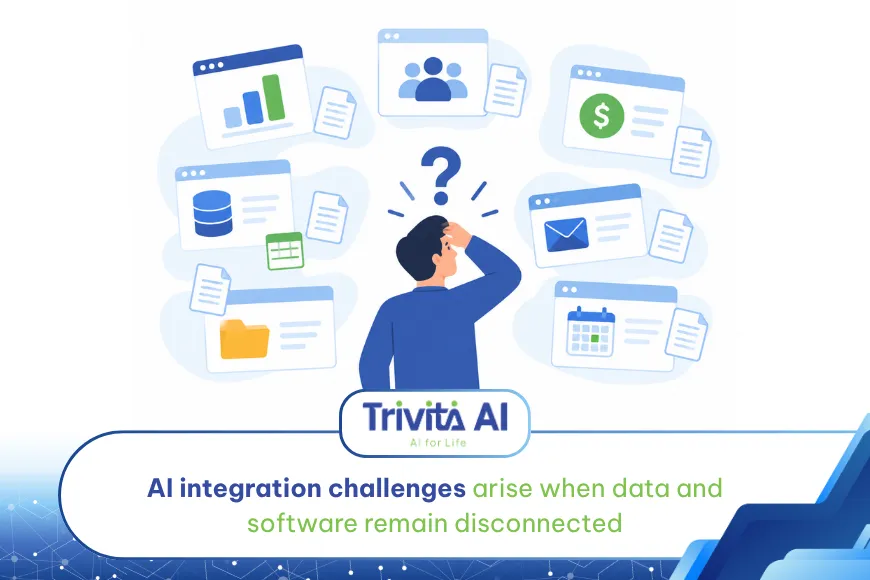
AI integration challenges arise when data, ERP, CRM, and business software remain disconnected. A shared platform helps AI integrate with enterprise systems.
Businesses can experiment with AI relatively quickly using a standalone tool. Users enter data, submit requests, and receive results directly through the tool’s interface. However, when businesses want to bring the same capabilities into real-world operations, the challenge becomes more complex: Where should AI retrieve data from? Which system should receive the output? And how can the technology participate in existing workflows?
This is where AI integration challenges begin to emerge. An AI system may perform well independently but still be difficult to connect with ERP, CRM, databases, or internal software that a business has been using for years.
The problem therefore does not necessarily lie in the capabilities of the AI model. The gap often exists between AI and the organization’s existing technology architecture, data, and workflows. To close this gap, businesses need to approach integration as a platform-level challenge rather than addressing each connection separately.
AI can perform well and still be difficult to integrate
A standalone AI tool typically operates in a relatively simple environment. Users actively provide inputs and directly receive outputs. In an enterprise environment, however, data and work move across multiple systems before a process is completed.
An AI system may need to retrieve information from management software, process the data, and then transfer the output to another system. A subsequent step may require human review before the information is updated in a business application. In this context, AI is only one component within a broader flow of work.
Without integration capabilities, users become the manual bridge between AI and other software. They copy data from one system into an AI tool, receive the output, and then enter it into another system. The technology may accelerate an individual task, but the overall workflow does not improve to the same extent.
AI integration challenges therefore need to be considered across the entire flow of data and work. For AI to participate more deeply in business operations, organizations need to address the gaps between new technology and the systems already in use.
Data is the first integration bottleneck
AI systems need data to generate relevant outputs, but enterprise data rarely exists in a single location. Information may be distributed across ERP, CRM, documents, databases, or software developed for individual departments.
Fragmented data increases the number of integration points
When an AI system needs information from multiple sources, each source may require a different method of integration and processing. If businesses deploy individual AI applications independently, the same data source may even need to be connected multiple times.
At this point, AI data integration challenges are not simply technical problems. Businesses also need to determine which data is actually required, where it should come from, and which step of the workflow it should support.
If these questions remain unresolved, adding more AI tools may make the data architecture more complex rather than enabling information to be used more effectively.
Data structures are not always ready for AI
Data created for business software is not necessarily structured in a way that AI systems can use directly. Information may be stored in different formats, lack consistency, or depend on how individual departments enter and manage data.
In addition, a significant portion of an organization’s knowledge may exist in documents or other unstructured data sources. AI systems require a different approach to utilize these sources compared with data that is already structured within business systems.
AI integration therefore needs to begin with an understanding of the data. Technical connectivity only creates a path between systems; whether the data is appropriate for the use case determines how effectively AI can use that path.
Access control needs to accompany connectivity
The fact that an AI system can connect to data does not mean it should have access to all data. Each application, user, and business function may require a different scope of information.
Integration architecture therefore needs to consider how data is used, not simply how it is transferred between systems. As AI becomes more deeply integrated into enterprise operations, access control becomes an important part of the overall integration architecture.
Even after addressing the data layer, businesses still face another challenge: systems such as ERP and CRM are built around their own business logic.
ERP and CRM make AI integration more complex
ERP and CRM systems often play central roles in enterprise operations. They do more than store data; they are also connected to workflows, user permissions, and business logic. Integrating AI into these systems is therefore more complex than simply connecting to an individual data source.
AI integration with ERP becomes difficult when it needs to enter business workflows
AI integration with ERP becomes challenging when the solution is designed as a tool that operates outside the system. ERP may contain data related to multiple business activities, and each action within the system belongs to a specific process.
If an AI system generates an output but that output cannot be transferred to the appropriate step in the business process, users still need to handle it manually. Having a technical connection to ERP therefore does not necessarily mean that AI has been integrated into operations.
Businesses need to determine which data the AI system should use, who the output is intended for, and where the next action should take place. Integration becomes meaningful only when these elements are connected into a continuous flow of work.
AI integration with CRM becomes difficult when information requires context
CRM systems contain extensive information about customers and their interactions with a business. AI can help businesses make use of this data, but its value depends on whether the technology can access the context required for each task.
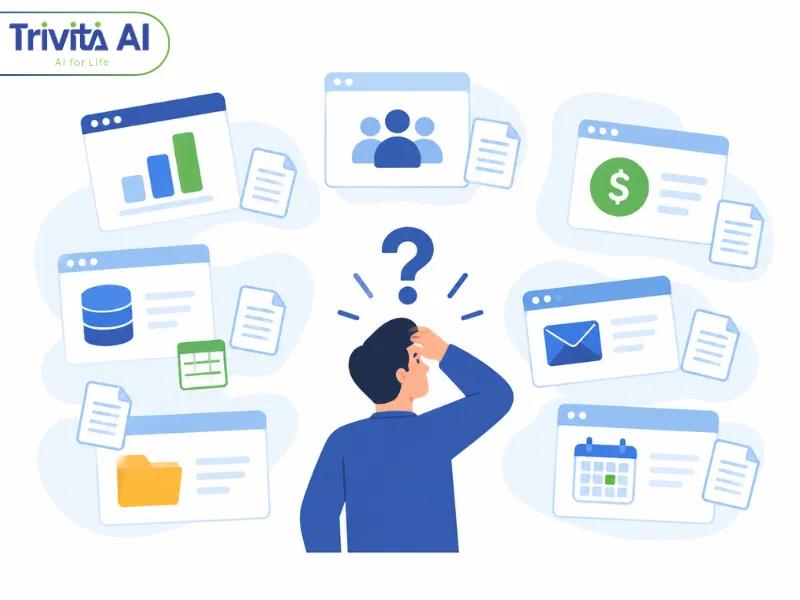
If users still need to extract data from CRM, transfer it into an AI tool, and then move the output back into the CRM system, AI remains outside the workflow. As more tasks are implemented in this way, the number of manual integration points increases.
AI integration with CRM therefore cannot be addressed simply by adding another AI feature. The technology needs to be positioned at the appropriate step in the workflow and use the right scope of data.
Internal software introduces additional layers of complexity
In addition to ERP and CRM, businesses may use specialized software or internally developed systems. Each system has its own architecture, data structures, and operating methods.
There is therefore no single formula for integrating AI with business software across every organization. The integration approach needs to reflect the existing architecture and the role each system plays within the workflow.
As the number of systems increases, integrating each AI application separately with individual software becomes increasingly difficult to manage. This is why businesses need to move from addressing individual connections toward building a shared capability layer.
A shared platform reduces fragmented integrations
If every AI application creates its own direct connections to ERP, CRM, and other data sources, the architecture can quickly become a complex network. Every new application introduces additional integration requirements, forcing businesses to repeatedly address similar challenges.
An integrated AI platform provides a different approach. Capabilities that can be shared are organized into an underlying layer so that applications built on top do not need to solve the entire data and integration challenge from the beginning.
This shared layer does not mean that businesses need to replace their ERP, CRM, or existing software. Instead, the objective is to enable AI to work with those systems. New technology is incorporated into the architecture based on what the organization already has.
When a new AI application is introduced, businesses can assess which connections and capabilities already exist. Reusable components can be inherited, while only the elements that are genuinely different need to be developed.
A platform-based approach also allows AI systems to participate in more workflows. Rather than simply receiving data and generating an isolated output, AI can connect with the preceding and subsequent steps of a process, while people remain involved at points that require review or decision-making.
As a result, the integration objective shifts from “How do we connect this AI tool to that software?” to “How do we build the capabilities required for AI to participate across enterprise systems?” This shift creates a stronger foundation for scaling AI over the long term.
Trivita AI approaches integration from real-world problems
Trivita AI approaches AI development by starting with the problem, data, and environment in which the technology will be used. This means that integration does not begin by asking how many systems AI should connect to, but by determining where AI needs to participate to effectively support users.
Once the problem has been defined, the relevant data and workflows can be analyzed to determine an appropriate integration approach. Capabilities related to language, computer vision, machine learning, data, and AI infrastructure can form the core technology layer, while applications built on top are developed around specific requirements.
This approach is particularly important in specialized domains. Healthcare, legal, and education systems have different data and workflows, which means AI cannot be integrated in exactly the same way simply because these domains use similar underlying technologies.
This direction is reflected in the Trivita AI ecosystem, including MedVita for healthcare, which is currently being deployed; VitaLaw for the legal sector, which is under development; and EdVita as the direction for education. Core AI capabilities provide the foundation, while the way technology connects with data and workflows still needs to be specialized for each context.
The ultimate objective is not to connect AI with as many software systems as possible. Integration should position the technology appropriately within the workflow, provide access to the right data, and help people perform their work more effectively.
Addressing AI integration challenges needs to start with the foundation
AI integration challenges emerge when businesses treat AI as a standalone tool that needs to be connected individually with ERP, CRM, data sources, and every software system already in use. As AI adoption expands, the number and complexity of these connections can increase significantly.
Addressing this problem requires businesses to begin by understanding their data and workflows, defining the role of each system, and building a shared capability layer that allows AI applications to reuse existing integrations rather than repeatedly starting from the beginning. With a human-centered and problem-driven approach, Trivita AI focuses on placing AI in the appropriate position within enterprise systems so that the technology does not remain an isolated layer, but instead helps people make better use of data, execute workflows, and access knowledge more effectively.
