
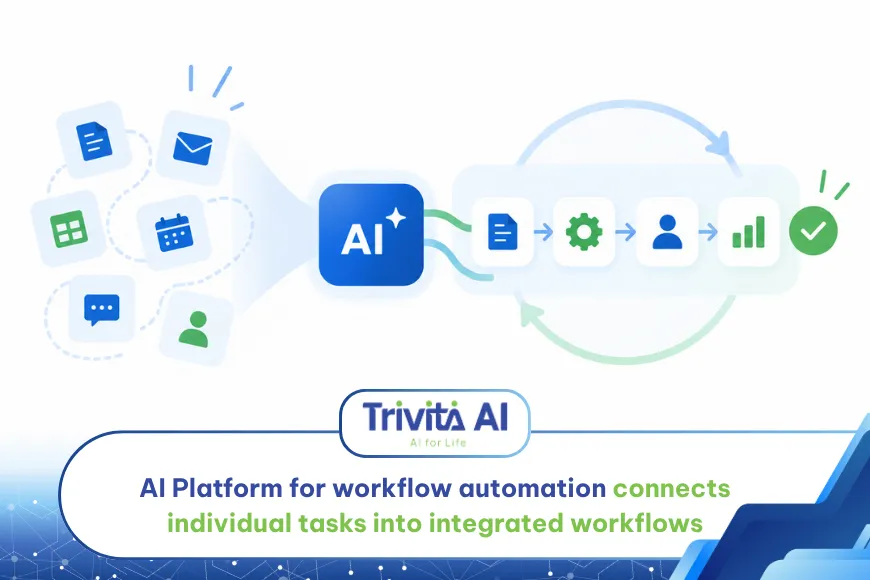
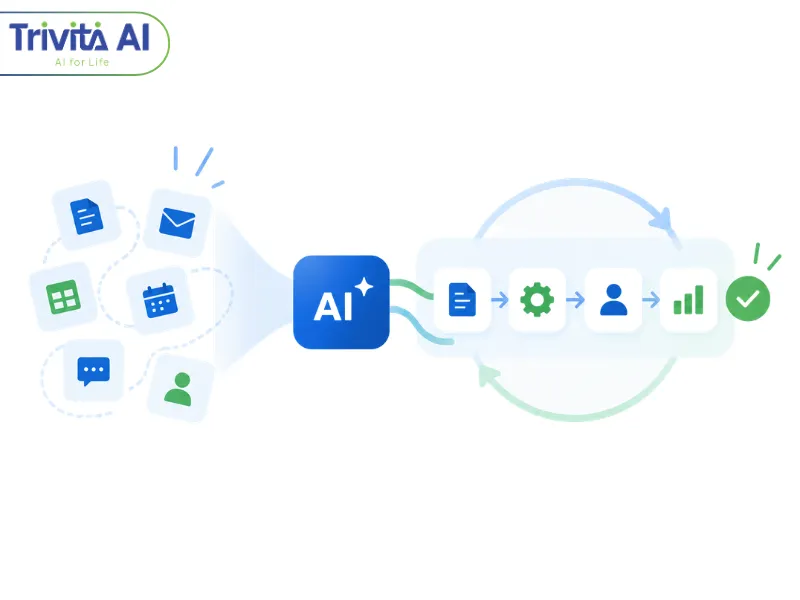
An AI Platform for workflow automation connects data, AI capabilities and workflows to help enterprises operate more seamlessly and efficiently.
Enterprises can begin adopting AI through relatively specific tasks such as document processing, information synthesis, data classification or helping users search for knowledge. When used independently, each application can make a particular task faster and more convenient. However, real-world work rarely consists of only one step.
A business process typically moves across multiple data sources, systems and people before producing a final outcome. If AI only supports isolated points in that process, users still need to transfer information between tools and manually handle many intermediate steps. The value of automation may therefore remain limited to the task level.
This is an important distinction when considering an AI Platform for workflow automation. Rather than applying AI to a single activity, the platform can provide the foundation for connecting AI capabilities with data, systems and workflow stages, enabling a more seamless operating process.
AI automation needs to go beyond individual tasks
An AI tool can perform a specific task very effectively. For example, a system may read documents, extract information or generate content based on user requests. However, once the AI system completes that task, the output may still need to be downloaded by a person, entered into another system or transferred to the next department.
In this situation, one step has been automated while the overall process still contains multiple interruptions. If enterprises continue adding tools in this way, the number of AI-assisted tasks may increase while users remain responsible for connecting separate systems.
Enterprise AI automation therefore needs to be considered more broadly. Organizations should not only determine which activities AI systems can perform, but also understand where those activities sit within the overall process, which data sources they depend on and where their outputs need to go next.
A workflow-oriented perspective helps enterprises avoid optimizing individual points without improving the entire work journey. A faster task creates greater value only when its output can be used effectively in subsequent stages.
This is also why an AI Platform for workflow automation becomes increasingly relevant as enterprises move AI from isolated experiments into operational processes. The focus shifts from the capabilities of an individual model to how those capabilities participate in an end-to-end workflow.
Workflows connect AI capabilities with data and operations
A workflow can be understood as the flow of work from an initial input to a final outcome. Throughout this flow, data is received, processed and transferred, often requiring interaction between multiple systems and people.
An AI Platform workflow enables AI capabilities to become part of this flow rather than remaining standalone tools. To achieve this, the platform needs to position AI technology in relation to both data and workflow logic.
Data needs to reach the right step at the right time
Each stage of a workflow may require different types of information. If data remains fragmented across multiple sources, users need to search for, consolidate or transfer information manually before an AI system can process it.
When a platform can connect to the appropriate data sources, the output of one stage can become the input for the next in a more structured way. AI technology can then be positioned at the appropriate point in the workflow rather than processing information only when a user manually submits a request.
This also requires enterprises to consider access permissions and how data is used. Automation does not mean that all information should move freely across systems. Data still needs to be managed according to users, business requirements and the standards of each operating environment.
Workflow logic determines where AI should participate
Not every step in a process requires AI technology. An effective workflow needs to distinguish between tasks that can be supported by technology, stages that can be automatically transferred and points where human review or decision-making remains necessary.
If an enterprise focuses only on automation potential, AI systems may be introduced into stages where they do not create meaningful additional value. When implementation begins with business workflow logic instead, the role of AI becomes clearer.
An AI Automation Platform should therefore not be understood as a platform designed to remove people entirely from business processes. Its value lies in reorganizing the flow of work so that technology handles appropriate activities while people continue to manage stages that require expertise, judgment and accountability.
An AI Platform provides a foundation for workflows to evolve without becoming fragmented
When enterprises automate individual processes using separate tools, each workflow can gradually become an independent system. This approach may address immediate requirements quickly but can create fragmentation as the number of applications increases.
One department may build its own workflow, another may use a different automation tool, while each system connects to data in its own way. As enterprises expand AI across more processes, these differences increase the complexity of management and development.
An Enterprise AI Platform provides a different approach. Reusable capabilities such as infrastructure, data access and selected core AI functions can be organized into a shared foundation, while workflows continue to be designed around specific business problems.
This does not mean that every process needs to be standardized in the same way. Marketing, operations, human resources and specialized professional teams continue to have different workflow logic. The shared foundation provides continuity and connectivity without eliminating the differences between business functions.
When a new workflow is developed, enterprises can build on existing capabilities rather than recreating the entire system. This creates the foundation for AI-driven process optimization to extend beyond isolated points and scale across a broader range of operations.
A platform-based approach also helps enterprises shift from asking, “Which tasks can we automate?” to asking, “Which capabilities should we build so that multiple workflows can use AI?” This shift becomes particularly important as AI technology becomes a long-term part of the enterprise operating environment.
Effective automation still requires people within the workflow
A higher degree of automation does not automatically result in a better process. In many environments, some stages require professional experience, judgment or accountability that enterprises should not delegate entirely to AI systems.
Workflow design therefore needs to clearly define the relationship between people and AI technology. AI systems can support the processing of large volumes of information, synthesize data or handle appropriate repetitive steps. People continue to participate where review, evaluation and decision-making are required.
This becomes particularly important when AI technology is applied in knowledge-intensive domains. In healthcare, legal services or education, automation needs to reflect the professional context and specific requirements of each industry. A workflow suitable for a general business process may not be directly applicable to a specialized environment.
An AI Platform for workflow automation therefore needs to both connect workflow stages and allow individual processes to be specialized. Technology provides a layer of supporting capabilities, while the way those capabilities are used remains determined by the real-world problem.
Keeping people in the appropriate positions within workflows also helps enterprises take a more practical approach to automation. The objective is not to minimize human involvement at all costs, but to reduce unnecessary manual steps so people can focus more of their time on specialized knowledge, higher-value work and decisions that require human judgment.
Trivita AI develops platforms around real-world problems and workflows
Trivita AI approaches AI development by starting with the problem and operating context before determining how technology should participate. The development process moves from understanding the industry and analyzing the problem to building the platform, deploying it in real-world environments and continuously evolving it according to emerging requirements.
Under this approach, automation is not simply a matter of introducing AI into an isolated task. Data, workflows, domain knowledge and relevant requirements need to be considered together to determine the appropriate role of technology.
Trivita AI develops capabilities in natural language processing, computer vision, machine learning, data and AI infrastructure while bringing together scientists, AI engineers and domain experts. Core technological capabilities provide a foundation for developing specialized applications for different operating environments rather than treating a single workflow model as a universal solution.
This direction is reflected in an ecosystem that includes MedVita for healthcare, which is currently being deployed; LawVita for legal services, which is under development; and EduVita as Trivita AI’s direction for education. Each domain has different workflows, data and specialized knowledge, so the way AI technology participates in those workflows also needs to reflect these specific characteristics.
Moving from shared platform capabilities to specialized applications allows AI systems to operate within an environment that can be reused and continuously developed while remaining relevant to real users. This also creates a foundation for automation to move beyond completing individual tasks faster and toward improving the overall flow of work.
Workflow automation should begin with how work actually happens
An AI Platform for workflow automation does not mean that every step should be delegated to AI. More importantly, it means determining how data, technological capabilities, systems and people can work together within a seamless workflow.
When enterprises move from automating isolated tasks to building connected and reusable capabilities, new processes can be developed on top of what already exists instead of continuing to create separate tools.
With its direction of developing specialized AI Platforms for individual industries, Trivita AI aims to place technology at the right points within workflows, reduce unnecessary manual activities and enable people to focus more on specialized knowledge, higher-value work and decisions that require human involvement.
