

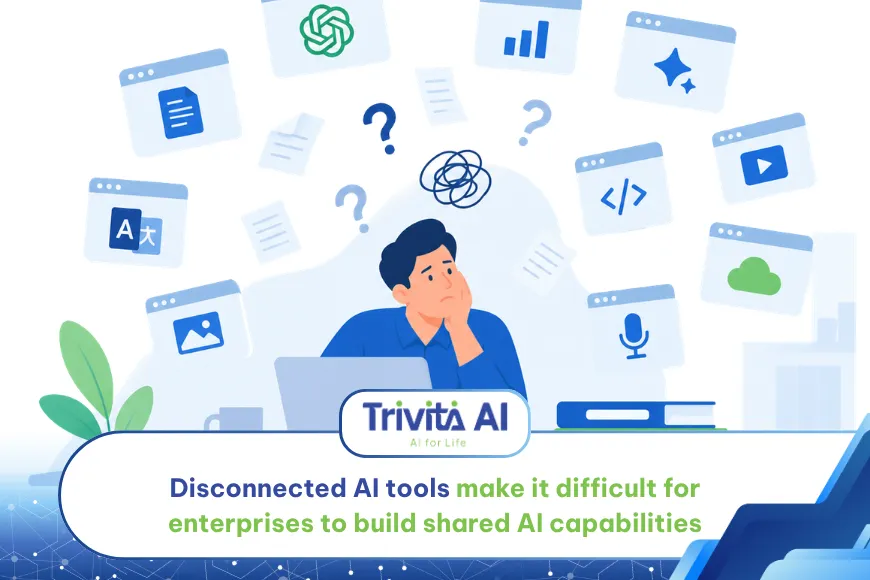
Disconnected AI tools fragment data and workflows, making it difficult for enterprises to build shared AI capabilities and scale them over time.
Enterprises can begin adopting AI technology to address a wide range of needs. Marketing teams may use a tool to support content creation, operations teams may experiment with AI systems for document processing, while other teams may deploy information retrieval systems or automate specific tasks. Each tool solves a particular problem and delivers a certain level of value to its users.
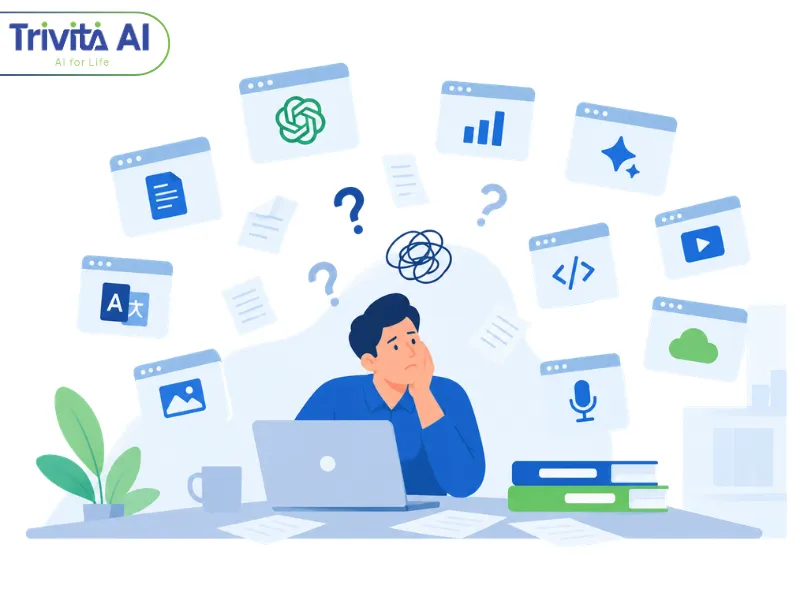
However, as the number of applications increases, a new challenge can emerge. These tools operate independently, rely on different data sources and are difficult to integrate into the same workflow. Enterprises may end up with disconnected AI tools, even though their overall level of AI adoption appears to have increased significantly.
At this point, the bottleneck is no longer a lack of tools. Enterprises need to consider how their AI capabilities are organized, connected to data and integrated into a shared technology environment. If every new requirement continues to be addressed with a separate tool, the number of AI applications may increase without a corresponding improvement in organization-wide AI capabilities.
AI fragmentation emerges when each need is addressed with a separate tool
Allowing departments to independently experiment with AI is a natural way for enterprises to begin adopting the technology. Each team understands its own challenges and can quickly select a tool for a specific task. This approach reduces the time required for experimentation and allows organizations to identify the value of AI at a small scale.
Fragmentation becomes more apparent when multiple independent experiments coexist within the same enterprise. One department may use its own AI tool, another may deploy a different system, while other applications may be developed for specialized business functions. Each solution has its own data, accounts, operating methods and scope of use.
At this stage, an enterprise may have multiple AI systems without establishing a unified set of AI capabilities. When the organization needs to connect data across departments or build workflows that span multiple systems, the limitations of fragmented AI deployment begin to emerge.
The issue is therefore not simply whether an enterprise has too many or too few tools. An organization may legitimately require multiple AI applications. The key question is whether these applications can operate on a shared capability layer or whether each tool is creating another isolated point within the enterprise technology environment.
Disconnected AI tools keep data and workflows fragmented
AI systems create value through their relationship with the data and workflows they support. When each tool operates independently, fragmentation can extend beyond the technology layer and affect how data is utilized and how work is performed.
Data struggles to become a shared enterprise resource
Each AI application may require its own set of data. When tools are not connected, the same type of data may need to be transferred into multiple systems or processed in different ways. This makes it difficult for enterprises to establish a consistent approach to data for AI applications.
With disconnected AI tools, information generated by one system may also be difficult to use naturally as input for another. Users may need to transfer data manually or complete additional intermediate steps before continuing their work.
The problem becomes more apparent when requirements extend beyond a single department. Enterprise data may already be distributed across multiple sources, and using it through separate AI tools adds another layer of fragmentation, making integration increasingly complex as the organization attempts to scale AI adoption.
Workflows become divided across isolated AI touchpoints
An enterprise workflow rarely begins and ends within a single tool. Work may move across multiple departments, information sources and processing stages before producing a final outcome.
If AI systems only appear as isolated points of support, users are responsible for connecting those points themselves. One tool generates an output, a person transfers that output to the next system, and the process continues in another application. AI technology may make individual steps faster while the overall workflow remains fragmented.
The effectiveness of an individual tool therefore does not fully represent efficiency at the organizational level. When evaluating AI adoption, enterprises need to consider the entire journey of data and work rather than measuring only the performance of individual tasks.
Without a shared AI foundation, scaling becomes increasingly complex
Disconnected AI tools may not create significant obstacles when an enterprise is running only a few experiments. However, as demand increases, every new system adds another layer that needs to be managed and integrated.
Enterprises may repeatedly need to address similar challenges involving data access, user permissions, infrastructure integration and the incorporation of AI-generated outputs into business workflows. If every application is built as an independent system, scaling AI means repeatedly solving the same foundational problems.
A shared foundation provides a different approach. Rather than requiring every application to be identical, enterprises can identify which core capabilities should be shared and which components need to remain specialized for specific requirements.
For example, different departments may require different applications while still sharing certain data sources, AI capabilities or infrastructure. When these components are organized as a common foundation, new applications can build on existing capabilities instead of starting from another isolated system.
A shared platform therefore does not mean consolidating every tool into a single application. The objective is to connect capabilities that need to be shared while maintaining enough flexibility for each solution to adapt to specific problems and users.
Connecting AI requires the ability to specialize for different needs
Addressing fragmentation does not mean enterprises should eliminate every existing tool and move to a single solution. Different departments continue to have different requirements, and in many cases they need applications specifically designed for their business functions.
The key is to establish a balance between shared platform capabilities and specialized applications. A common technology layer can provide the foundation for sharing essential components, while applications built on top of it can continue to address individual use cases.
This approach becomes particularly important when AI technology enters domains with clearly defined professional knowledge and workflows. A healthcare application cannot be designed in the same way as a legal application simply because both use AI technology. Core technological capabilities may be shared, but data, knowledge, workflows and usage requirements still need to be addressed according to each domain.
Enterprises therefore do not have to choose between using one tool for every requirement and building completely independent systems for every use case. A shared platform can provide connectivity, while specialization ensures that AI systems remain appropriate for the environments in which people actually work.
This also creates a foundation for enterprises to move from owning multiple AI tools to building organizational AI capabilities. Value is no longer measured simply by the number of applications deployed, but by how effectively those applications contribute to shared data, workflows and organizational objectives.
Trivita AI connects core platform capabilities with specialized applications
Trivita AI approaches AI development by building core technological capabilities and developing specialized platforms for individual domains. Rather than treating a single general-purpose model as a solution that can be applied unchanged to every requirement, the technology is developed in relation to specific problems, data, domain knowledge and real-world workflows.
This approach creates two interconnected layers. Core AI capabilities provide a technological foundation for development, while individual solutions continue to be specialized according to their operating environments. Trivita AI develops capabilities in natural language processing, computer vision, machine learning, data and AI infrastructure while bringing together scientists, AI engineers and domain experts throughout the development process.
The direction of combining a shared foundation with multiple specialized capabilities is also reflected in the Trivita AI ecosystem. MedVita for healthcare is currently being deployed, VitaLaw for the legal sector is under development, and EdVita represents Trivita AI’s direction for education. Each branch has distinct data, knowledge and operating requirements while sharing the same human-centered approach to AI development.
This structure is designed to prevent AI technology from existing merely as a collection of independent tools that solve isolated tasks. Technological capabilities need to be reusable and extensible, while individual applications remain specialized enough to serve the people and contexts for which they are designed.
From disconnected AI tools to connected enterprise capabilities
Disconnected AI tools demonstrate why the number of AI applications alone does not fully reflect an organization’s AI maturity. When data remains fragmented, workflows still depend on manual connections and every new requirement introduces another independent system, enterprises struggle to transform isolated experiments into AI capabilities that can be shared and developed over the long term.
The appropriate approach does not necessarily involve replacing every tool with a single solution. Instead, enterprises need to identify which capabilities, data and infrastructure should be organized on a shared foundation while maintaining the ability to specialize applications for individual departments and domains.
By connecting core AI capabilities with specialized platforms, Trivita AI is developing an ecosystem in which technology can evolve according to specific use cases while keeping people, data and real-world requirements at the center.
