

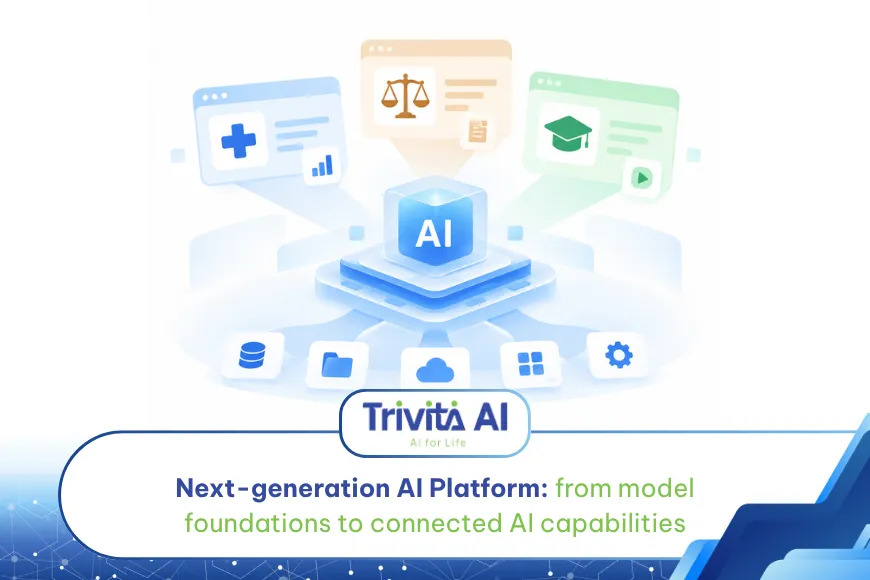
A next-generation AI Platform connects models, data, workflows, and AI Agents on an integrated, specialized, and adaptable foundation.
AI is evolving from tools designed for individual tasks into a technology layer capable of participating more deeply in business operations. As enterprise needs change, the way businesses build the foundation for AI also needs to evolve.
A platform that only provides access to AI models may be suitable during the experimentation stage. However, when AI needs to use enterprise data, connect with software, participate in workflows, and support different business functions, the model becomes only one component within a broader architecture.
A next-generation AI Platform therefore should not simply be understood as a platform that uses newer AI models. The more important shift lies in its ability to connect multiple layers of capabilities so that AI can move from experimentation to operations, from individual tasks to workflows, and from shared technology to applications designed for specific domains.
AI Platforms are moving beyond the model layer
In the early stages, many AI applications were developed around the capabilities of the model. Businesses selected a technology, provided inputs, and used the outputs to support a specific task.
This approach remains valuable, but as the number of applications increases, businesses begin to face questions that extend beyond the model itself. Where does AI retrieve its data? How are outputs transferred to the next system? Can applications reuse existing capabilities, or does every project need to rebuild them from the beginning?
This is why a modern AI Platform needs to go beyond providing a collection of models.
The platform becomes a connecting layer between AI, data, systems, workflows, and the applications built on top. Models remain important, but the value of the platform increasingly depends on how these capabilities are incorporated into real-world operations.
This shift also changes the questions businesses need to ask. Instead of focusing only on “What can AI do?”, organizations need to consider “How can AI work with what the business already has?”
Data becomes the foundation of modern AI
An intelligent AI Platform needs more than the ability to process inputs directly provided by users. To participate more deeply in enterprise operations, AI needs access to the appropriate data within the right context.
AI needs to connect with multiple data sources
Enterprise data is often distributed across ERP, CRM, databases, documents, and specialized software. If every AI application develops separate connections to each source, the architecture becomes increasingly complex as the number of use cases grows.
A next-generation AI Platform needs to provide a foundation that enables applications to access the data sources they require without continuously rebuilding the entire integration layer.
This does not mean that all data needs to be centralized in one place. More importantly, businesses need the ability to identify where data resides, which applications need it, and how information can be delivered to the appropriate task.
Context determines the value of data
AI does not simply need data; it needs the right data for the right task. A system may receive large amounts of information, but without the appropriate context, its outputs may still be difficult to use.
The data layer of a Future AI Platform therefore needs to be connected with the problem and workflow. Information provided to AI should reflect the context in which users are working rather than simply providing access to the largest possible data repository.
When data can move to the appropriate application, AI can begin to shift from a tool that waits for users to provide inputs toward a capability that actively participates in operations.
Workflows move AI from tools into operations
If data provides AI with context, workflows bring those capabilities into actual work. This represents one of the most important shifts as an AI Platform evolves from a technology foundation into a platform that supports operations.
AI needs to participate across connected steps
Real-world work rarely consists of a single task. Data is received, processed, reviewed, transferred to the next step, and ultimately leads to an action or decision.
If AI supports only one step while users still need to manually transfer the output to other systems, the technology remains an isolated point within the process.
A modern AI Platform needs to enable AI capabilities to participate directly in workflows. The output of one step can become the input for the next, while data moves appropriately between AI systems, software, and users according to the process.
People retain the necessary control points
An AI-enabled workflow does not mean that the entire process is handed over to machines. Each step needs to be assessed to determine which parts are appropriate for automation, which can be supported by AI, and which require human evaluation.
This structure is particularly important for business functions that require professional expertise. AI can help process large volumes of information or perform appropriate tasks, while people remain responsible at points that require experience and decision-making.
An intelligent AI Platform therefore does not simply aim to increase the number of automated steps. The platform needs to help AI systems and people work together more effectively throughout the workflow.
Once workflows are connected, the next stage of development is enabling AI components to proactively perform sequences of tasks within a defined scope.
AI Agents expand automation capabilities
AI Agents are opening an important direction for the development of AI platforms. Instead of responding only to individual requests, an Agent can be designed to perform multiple steps toward completing a defined objective within an assigned scope.
However, adding Agents does not automatically transform a platform into a next-generation AI Platform. Agents create value only when they can work with enterprise data, tools, and workflows.
Agents need to connect with enterprise systems
An Agent operating outside enterprise systems faces limitations similar to those of a standalone AI tool. Without access to the necessary data and software, its ability to perform tasks remains limited.
The platform therefore needs to provide a connectivity layer that allows Agents to use appropriate capabilities within each workflow. When a task requires multiple steps, an Agent can interact with other components instead of requiring users to continuously transfer data manually.
Agents need to operate within clearly defined boundaries
The ability to act proactively does not mean that an Agent should be authorized to perform every action. The appropriate level of automation depends on the type of task, the data involved, and the impact of the decision.
Some steps may be performed automatically, while other actions require human confirmation or evaluation before the process can continue.
The trend toward AI Platforms with integrated Agents therefore needs to be accompanied by controlled workflow design. The value does not lie in removing people from the process, but in distributing work more appropriately across people, AI systems, and automated systems.
Future platforms need to be both open and specialized
As AI expands into more industries, a general-purpose AI Platform faces two requirements. The platform needs to be flexible enough to connect with different technologies and systems while also being sufficiently specialized to support domain-specific business functions.
This is why AI Platform trends are not simply moving toward adding more models. Platform architectures need to allow technology capabilities to be reused while individual applications continue to be developed according to their domains.
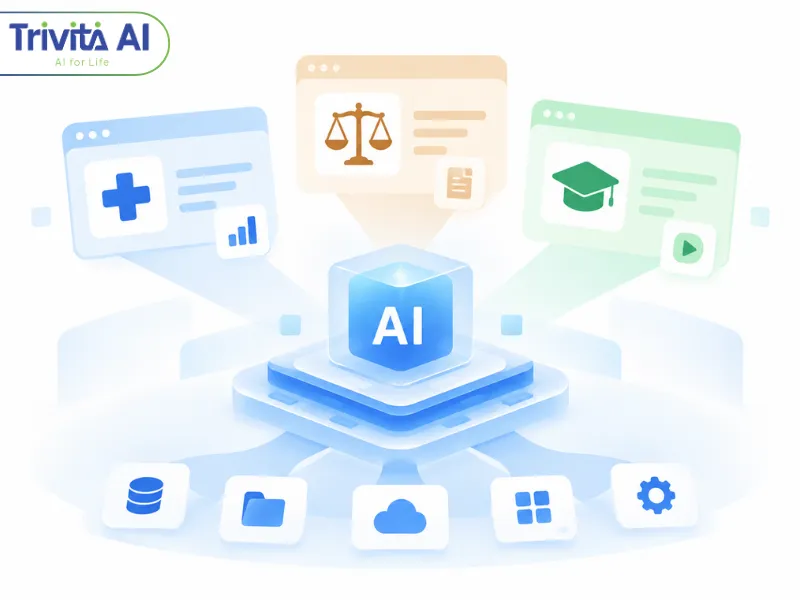
At the foundation layer, capabilities related to language, computer vision, machine learning, data, infrastructure, workflows, and Agents can serve as shared components. At the application layer, industry-specific data, knowledge, and processes can be added according to each domain.
This structure addresses two challenges at the same time. Businesses do not need to rebuild the entire technology stack for every application, but they also do not need to use the same solution for every business function.
Trivita AI approaches platform development by connecting technology capabilities with specific contexts of use. Reusable components form the foundation, while applications built on top are developed around the data, business functions, and needs of people.
This direction is reflected in MedVita for healthcare, which is currently being deployed; VitaLaw for the legal sector, which is under development; and EdVita as the direction for education. Each domain can reuse appropriate AI capabilities while maintaining its own specialized layer.
From this perspective, future platforms need more than stronger technology. They need the ability to adapt as models evolve, as businesses add new data, as workflows develop, and as new domain-specific problems emerge.
A next-generation AI Platform is defined by its ability to evolve with changing needs
A next-generation AI Platform is not simply a platform that uses newer AI models. It represents a shift from an isolated technology layer toward an architecture capable of connecting models, data, systems, workflows, and AI Agents.
When shared capabilities can be reused while applications continue to be specialized for individual domains, the platform can evolve alongside changing needs rather than remaining limited to a fixed set of tasks. With a human-centered approach, Trivita AI views this evolution as a way for AI to participate more deeply in work while keeping the technology connected to data, domain expertise, workflows, and the decision-making role of people.
