

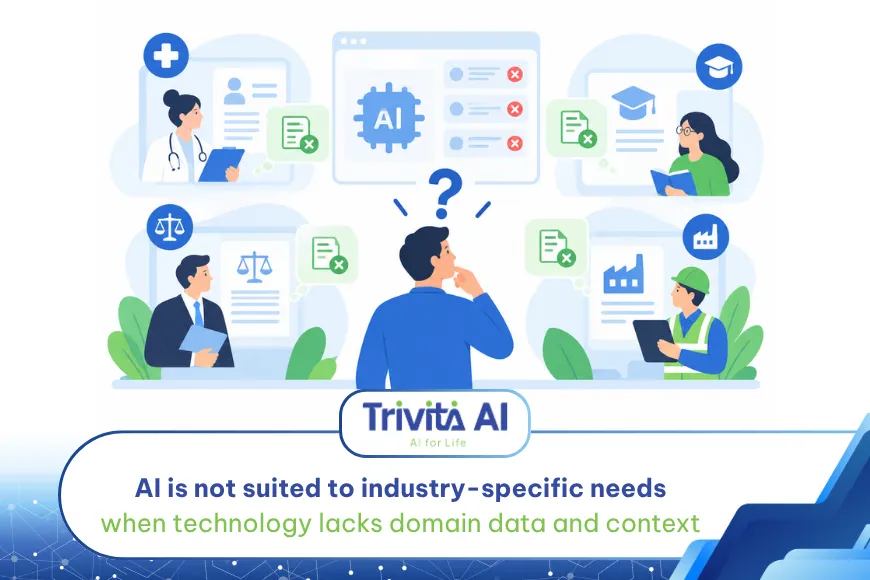
AI is not suited to industry-specific needs when it lacks domain data, context, and expertise. Domain-specific AI brings technology closer to real-world needs.
An AI system can process text, analyze images, or support information retrieval across many different situations. This broad applicability is one of the reasons AI has quickly been introduced into a wide range of activities. However, as the technology moves deeper into fields such as healthcare, legal services, and education, general-purpose capabilities may no longer be sufficient.
Each industry has its own terminology, data, workflows, and ways of using information. A response that appears reasonable in a general context may not meet the requirements of a specialized task. Technology therefore needs to understand not only the content provided by users but also the context in which that information is being used.
The problem of AI not suited to industry-specific needs emerges when the gap between general-purpose AI capabilities and specialized requirements remains unresolved. To close this gap, businesses need to move away from applying the same AI tool to every problem and toward developing AI around specific domains.
General-purpose AI reaches its limits in specialized industries
General-purpose AI offers the advantage of supporting different user groups and a wide range of tasks. For common needs such as drafting, summarization, or information processing, a general-purpose tool can provide value without requiring significant changes to existing systems.
Specialized work, however, often introduces more demanding requirements. Users need AI systems not only to understand language but also to recognize terminology, context, and relationships between information within a specific field.
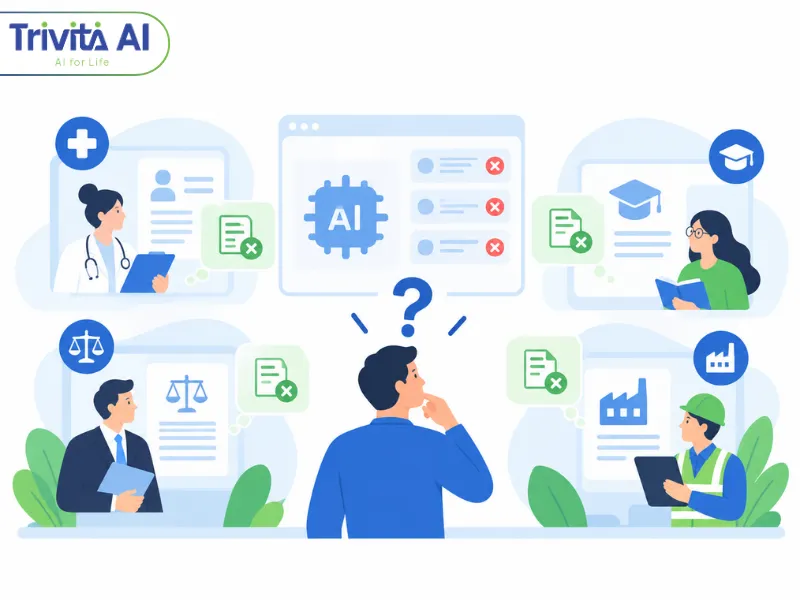
In healthcare, a concept may need to be interpreted within a specific clinical context. In legal environments, information processing needs to reflect relevant documents, regulations, and the context of the issue. In education, the way technology supports learners also depends on learning objectives and how the educational process is structured.
If businesses rely only on a general-purpose AI layer without specialized components, the gap between technological capabilities and real-world requirements remains.
This is not necessarily a limitation of AI itself. The issue arises when technology designed to serve a broad range of purposes is expected to directly address problems with highly specific contexts.
The domain determines how AI needs to be developed
Domain-specific AI begins with a different principle: before determining what the technology should do, businesses need to understand the environment in which it will operate. A domain is more than the name of an industry. It includes data, knowledge, users, and how work is performed.
Data in each industry carries its own context
Healthcare, legal, and education data differ in more than their content. Their structures, terminology, and purposes for using information are also different.
The same language processing capability therefore cannot necessarily be applied unchanged across every field. AI systems need access to the appropriate data sources and need to process information within the context of the problem being addressed.
This also means that having more data does not automatically produce a better solution. What matters is whether the data is relevant to the business function, appropriately organized, and used within the right scope.
Domain expertise provides the necessary layer of understanding
An AI system may recognize words and expressions, but this does not mean it fully understands the specialized meaning behind them. The same term may carry different implications depending on its context.
Industry-specific AI therefore needs to be developed with domain knowledge incorporated into the process. Domain experts help define the problem, determine how information should be interpreted, and identify where AI-generated outputs need to be reviewed.
AI engineers understand how the technology works, while domain experts understand the environment in which it will be used. These two layers of expertise need to work together if the objective is to move AI from technical capability to real-world application.
Users determine how AI should participate
The same technology may be used very differently by doctors, legal professionals, educators, or enterprise employees. Each user group has its own objectives, responsibilities, and workflows.
Domain-specific AI is therefore not simply about adding industry data to a model. How users interact with AI and where the technology is positioned within the workflow also need to be designed around the domain.
Once the domain is understood, the next challenge is turning that knowledge into a solution that can participate directly in specialized workflows.
Industry-specific AI needs to work within business processes
Industry-specific AI creates practical value only when the technology is positioned appropriately within the flow of work. Even if a system understands specialized terminology, it can remain outside the workflow if users still need to manually transfer information between AI and other software.
AI designed around business processes therefore goes one step beyond AI that simply contains industry knowledge. The technology needs to understand which step it is supporting, where the input data comes from, and how its output will be used.
AI needs to address a specific problem
The starting point should not be the question, “Where can this industry use AI?” A more practical approach is to identify an existing problem and determine whether AI technology is appropriate for supporting it.
Some problems may involve large volumes of information, repetitive tasks, or the need to retrieve knowledge. Others depend heavily on professional judgment and may not be appropriate to delegate entirely to AI systems.
When the problem is defined first, businesses can establish a clearer role for technology rather than attempting to introduce AI into every step.
AI needs to connect with existing workflows
Real-world business functions usually already have established processes and supporting systems. AI does not operate in isolation and needs to interact with these existing components.
A solution may need to retrieve information from a business system, process the data, and then provide results to users or transfer them to the next step. Points that require human evaluation remain part of the workflow.
This is also why industry-specific AI should not be equated with replacing domain experts. In fields that require specialized expertise, technology can support information retrieval and handle appropriate tasks, while people continue to play central roles at points that require judgment and accountability.
As the number of industry-specific use cases increases, developing each application independently creates another challenge. Businesses need a foundation that allows technology capabilities to be reused while still enabling specialization for individual domains.
A Vertical AI Platform connects foundational technology with domain expertise
A Vertical AI Platform can be understood as an AI platform developed for a specific industry or group of specialized business functions. Rather than attempting to address every problem in the same way, the platform combines core AI capabilities with the data, knowledge, and workflows of a particular domain.
This approach involves two layers that need to coexist.
The first layer consists of reusable technology capabilities such as language processing, computer vision, machine learning, data, and AI infrastructure. Organizing these capabilities at the platform layer means that individual applications do not need to rebuild the entire technology stack from the beginning.
The second layer is specialization. This is where industry data, domain knowledge, workflows, and the experiences of specific user groups are incorporated into the solution.
As a result, domain-specific AI does not mean that every industry needs to develop an entirely separate technology system. Appropriate capabilities can still be reused, while the elements that determine whether AI is suited to real-world requirements are developed according to the domain.
A shared platform enables technology capabilities to be reused
If every specialized use case is developed as a completely independent project, many technology components may need to be rebuilt. This increases fragmentation as the number of AI applications grows.
A platform layer provides the foundation for organizing and reusing shared capabilities. A new use case can build on appropriate existing components before adding the specialized elements it requires.
The industry-specific layer keeps AI aligned with real-world needs
The ability to reuse technology does not mean standardizing every industry in the same way. The industry-specific layer is what allows AI systems to adapt to the language, data, workflows, and users of each domain.
This represents an important balance within a Vertical AI Platform: sufficiently shared to avoid continuously rebuilding the underlying technology, yet sufficiently specialized to prevent AI from becoming a general-purpose tool placed into a professional environment without adaptation.
With this structure, businesses can develop domain-specific AI while maintaining the ability to scale on top of a reusable technology platform.
Trivita AI develops from the platform layer to individual industries
Trivita AI approaches AI by starting with the industry and the problem people need to solve. Rather than treating a general-purpose AI model as the answer to every requirement, technology is developed in relation to the data, knowledge, and workflows of each domain.
At the foundation layer, capabilities related to language, computer vision, machine learning, data, and AI infrastructure provide the basis for development. Reusable capabilities allow new applications to build on what already exists instead of always starting from the beginning.
At the specialized layer, each industry needs to be approached according to its own context. This direction is reflected in the Trivita AI ecosystem, with MedVita for healthcare currently being deployed, VitaLaw for the legal sector under development, and EdVita representing the direction for education.
MedVita is not simply a general-purpose AI tool introduced into a healthcare environment. Similarly, the development of VitaLaw and EdVita needs to position AI in relation to the corresponding knowledge, data, users, and workflows of the legal and education sectors.
This approach reflects Trivita AI’s human-centered AI philosophy. Technology is specialized not to eliminate the role of domain experts, but to better support people within the professional environments in which they work.
AI becomes suited to an industry when it understands the context of use
AI not suited to industry-specific needs becomes a problem when businesses expect general-purpose AI capabilities to directly address use cases that depend on specialized data, knowledge, users, and workflows.
Closing this gap requires a domain-specific approach in which shared technology capabilities form the underlying foundation while individual applications are specialized according to their real-world contexts. This is also the direction behind Trivita AI’s MedVita, VitaLaw, and EdVita ecosystem, which aims to bring AI closer to individual industries so that technology can help people access information, use specialized knowledge, and perform their work more effectively without replacing the professional role of human experts.
