

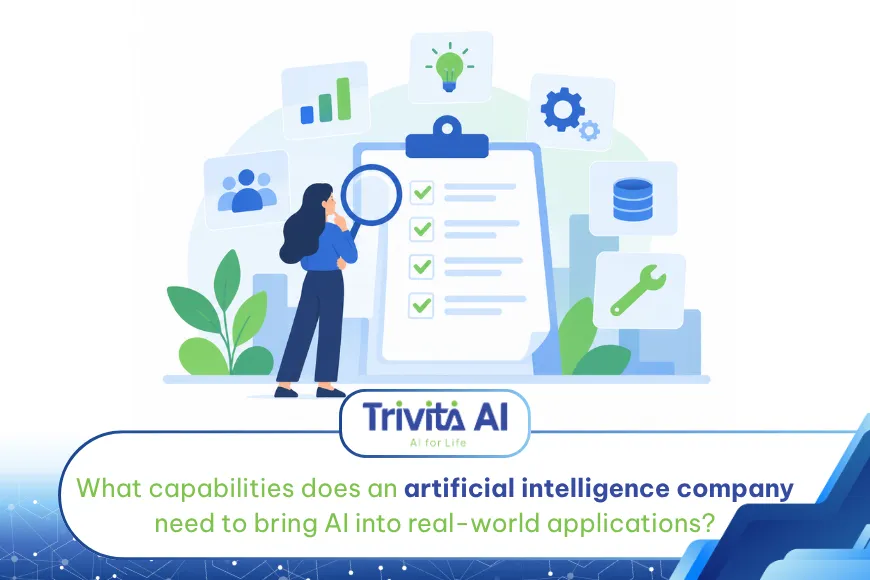
An artificial intelligence company needs to connect technology, data, and domain expertise to develop AI solutions for real-world problems and environments.
AI is becoming increasingly present across business operations, from data processing and document analysis to workflow automation and helping people access information. Alongside this growing demand, the market has also seen an increasing number of providers offering AI-related tools, platforms, and solutions.
However, the ability to provide a tool with AI features does not fully reflect the capabilities of a company that develops AI solutions. As the technology becomes more deeply integrated into real-world operations, the challenge extends beyond selecting the right model to include data, infrastructure, workflows, domain knowledge, and how people use the resulting outputs.
Therefore, when evaluating an artificial intelligence company, it is important to look beyond the technologies it offers. Businesses should also consider whether the company can transform AI capabilities into solutions suited to specific problems, integrate them into real-world environments, and continue developing them as requirements evolve.
An AI company needs to go beyond providing a tool
A business may begin adopting AI through readily available tools. This can be an effective way to experiment with the technology for specific tasks and quickly assess its potential. However, as requirements become more specialized, general-purpose tools may no longer fully address the problem.
A real-world workflow typically involves internal data, existing systems, user practices, and requirements specific to each industry. If an AI solution operates outside these elements, users may still need to perform multiple manual steps to incorporate AI-generated outputs into their work.
An AI company therefore needs more than the ability to use models. A more important capability is determining where the technology should participate, how data should be used, and which systems need to be connected to create practical value.
This also distinguishes providing an AI feature from developing an enterprise AI solution. A feature may address an individual task, while a solution needs to operate within the broader context in which it will be used.
When evaluating an AI development company, businesses should examine how the provider approaches problems. If the process consistently begins with technology before understanding the actual need, the resulting solution may offer many capabilities while still struggling to integrate deeply into real-world operations.
AI development capabilities need to connect technology with data and business processes
An AI solution is not built by a model alone. Its quality and practical applicability also depend on how data is organized, infrastructure is developed, and domain knowledge is incorporated into the development process.
The capabilities of an AI implementation company should therefore be viewed as a combination of multiple components rather than being assessed solely through a single technology.
Technology capabilities provide the foundation for AI solutions
Depending on the problem, AI applications may involve natural language processing, computer vision, machine learning, data technologies, or other technical capabilities. Development teams need to understand the characteristics of different approaches so they can select appropriate technologies rather than applying the same model to every problem.
Beyond the model itself, infrastructure also plays an important role. An experiment may perform well on a small scale, but as the number of users and the volume of data increase, requirements for operations, integration, and further development also change.
An artificial intelligence company therefore needs to view an AI solution as a system. The model is an important component, but data, infrastructure, and integration capabilities are what enable the technology to become part of long-term operations.
Understanding business processes helps place AI in the right context
The same AI capability can be used very differently across industries. A language processing system in a legal environment must work with different data, terminology, and workflows from an application designed for education or healthcare.
Domain knowledge therefore needs to be incorporated into the development process. Technology teams understand how to build the system, while domain experts help define the problem, context, and how the outputs will ultimately be used.
This combination helps avoid treating AI as a universal solution for every industry. Technology can provide the core capability layer, but the applications built on top still need to be specialized for their real-world environments.
Implementation capabilities determine whether AI can move from experimentation to operations
A model that performs well during experimentation does not necessarily mean the solution is ready for enterprise use. When AI moves into real-world operations, the technology needs to work alongside existing data, software, workflows, and users.
An AI implementation company therefore needs to bridge the gap between technical capabilities and operational readiness. This is the stage where many challenges that do not appear during experimentation begin to become visible.
For example, data needs to reach the right step in a workflow, AI-generated outputs need to move into subsequent systems, and access permissions need to be appropriate for different user groups. A solution may produce high-quality results but still be difficult to use if people constantly need to transfer data manually between the AI system and other tools.
Integration capability is therefore an important part of implementation. AI needs to fit within the existing technology architecture rather than becoming another isolated system.
The solution also needs to remain adaptable. Data changes, workflows evolve, and user requirements do not remain static. An AI project should not be considered complete as soon as the system begins operating.
Real-world implementation capabilities help distinguish a technology experiment from a capability that can evolve alongside the business. The value lies not only in what an AI system can do in a testing environment, but also in how people can use the technology in their daily work.
Artificial intelligence companies in Vietnam can grow through specialized use cases
The AI market is not limited to developing increasingly large models. Another important direction is bringing AI capabilities closer to specific business and industry problems.
This creates an opportunity for artificial intelligence companies in Vietnam to focus on understanding local contexts, data, and market requirements. Value does not necessarily come from developing a technology capable of solving every problem, but from combining the right capabilities to build solutions for specific use cases.
A specialized approach also reflects the nature of AI adoption. Healthcare, legal services, education, and enterprise operations each have different languages, data, workflows, and users. If the same general-purpose tool is introduced into all of these environments, a significant gap may remain between technological capabilities and real-world requirements.
An AI company can therefore create value by developing a reusable technology capability layer and then specializing it into platforms and applications for individual industries.
This approach also helps avoid two extremes: rebuilding the entire technology stack for every use case or attempting to apply the same solution across every industry. Core capabilities can be shared, while data, knowledge, and workflows continue to be developed according to each specific context.
Trivita AI develops AI through a platform-based and specialized approach
Trivita AI follows a human-centered approach to AI development, where technology is designed to work alongside and support people rather than replace their roles. The process begins by understanding the domain and the problem before determining how AI technology should participate.
At the technology layer, Trivita AI develops capabilities related to language, computer vision, machine learning, data, and AI infrastructure. Bringing together scientists, AI engineers, and domain experts provides a foundation for connecting technology capabilities with real-world requirements.
Reusable capabilities form the underlying platform layer, while solutions built on top are specialized for individual domains. This structure is designed to avoid developing completely isolated AI applications while also avoiding the use of an unchanged, general-purpose solution for every problem.
This direction is reflected in the Trivita AI ecosystem, including MedVita for healthcare, which is currently being deployed; VitaLaw for the legal sector, which is under development; and EdVita as the direction for education. Each has its own data, knowledge, and workflows, while all are developed around the principle of connecting technology with people and domain expertise.
Under this approach, the value of AI is not measured by how many jobs the technology can replace. What matters more is how AI systems can help people make better use of information, access knowledge, and perform their work more effectively within each specific environment.
An artificial intelligence company creates value when technology solves real-world problems
An artificial intelligence company is defined not only by its ability to own or use emerging AI technologies, but also by its capacity to connect technology with data, business processes, systems, and people to create solutions that can operate in real-world environments.
When core AI capabilities are developed as a reusable foundation while individual applications are specialized for specific industries, AI has a stronger basis for evolving from isolated experiments into a long-term organizational capability. This is also the direction Trivita AI follows in developing its industry-specific AI ecosystem: placing people at the center and treating technology as a tool for addressing real-world problems rather than as an end in itself.
