

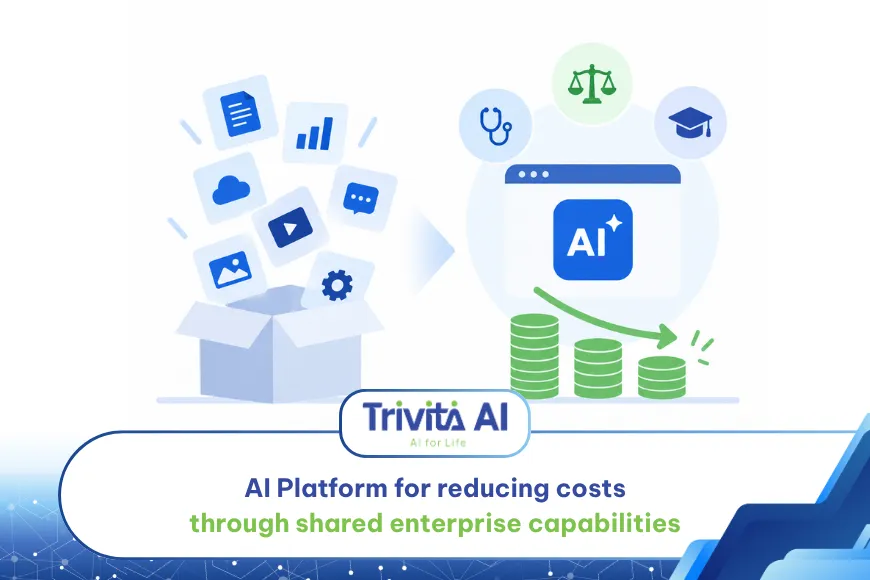
An AI Platform for reducing costs helps enterprises limit fragmented AI investments, reuse shared capabilities and scale more efficiently.
AI adoption can begin quite simply. One department selects a tool for a specific need, another team experiments with a new solution, or an enterprise develops an application for a particular workflow. However, as the number of requirements grows, the cost of AI no longer comes from a single tool or isolated project.
Enterprises may need to maintain multiple systems, repeatedly connect the same data and continue investing in similar technology components across different projects. AI systems may create value at the task level, while the way the technology is organized remains inefficient at the enterprise level.
This is an important perspective when discussing an AI Platform for reducing costs. The value does not simply come from using AI technology to perform a task at a lower cost than people. It also comes from building technological capabilities that can be shared, reused and continuously developed, reducing repetitive investment as AI adoption expands.
AI costs increase when applications are developed independently
During the early stages of adoption, deploying separate tools can be a fast way for enterprises to experiment with AI. Each department can select a solution that fits its own requirements and evaluate the value of the technology without changing the entire enterprise system.
However, this approach begins to create pressure as the number of applications increases. Marketing may use one tool, operations another system, while specialized teams continue developing solutions for their own professional workflows. If these systems cannot share capabilities, the enterprise may repeatedly invest in solving similar problems.
Costs also extend beyond purchasing or developing technology. Every system involves data, integration, infrastructure, operations and adjustments to fit user requirements. The more independent applications an enterprise maintains, the more separate technology environments it needs to manage.
This does not mean that enterprises should use only one AI tool. Different departments and domains still require applications suited to their own workflows. The key question is whether those applications are developed entirely in isolation or can inherit some of the capabilities the organization has already built.

An AI Platform optimizes costs by creating reusable capabilities
An Enterprise AI Platform can create a shared capability layer on which multiple applications can be developed. Instead of rebuilding every component for each project, enterprises can determine which capabilities are reusable and which components need to remain specialized.
This provides an important foundation for understanding how an AI Platform for reducing costs creates value. The platform does not necessarily eliminate every individual investment, but it can help enterprises avoid solving the same foundational technology problems repeatedly.
Core capabilities do not need to be rebuilt for every application
Different AI applications may still rely on similar technology components. When reusable components are organized at the platform level, new applications can inherit those capabilities rather than always starting from the beginning.
This approach becomes particularly valuable when an enterprise wants to expand AI across multiple departments. Each team can still have its own user experience and functionality, while the underlying technological capabilities are organized in a way that allows them to be shared.
In this context, an AI Platform for reducing costs supports optimization through reuse and continued development on top of an existing foundation rather than treating every new requirement as an entirely independent technology project.
Data and infrastructure can be managed more consistently
Data is one of the areas that can significantly increase AI implementation costs when every application handles it differently. The same information source may need to be connected multiple times, or enterprises may need to build separate data pipelines for individual systems.
A shared foundation allows organizations to approach data and infrastructure in a more consistent way. This does not mean that every application should have access to every dataset. Instead, the enterprise gains a stronger basis for organizing data connections, permissions and usage according to specific requirements.
As the platform develops, new applications can reuse parts of the infrastructure and data environment that have already been established. This is one of the mechanisms through which enterprises can limit rising costs caused by increasing system fragmentation.
Cost savings also emerge during AI operations and expansion
AI costs do not end once an application is deployed. Enterprises still need to operate, monitor, adjust and develop solutions as data, workflows and user requirements evolve.
If every AI system exists independently, management activities also become fragmented. A change involving data or infrastructure may need to be handled differently across multiple applications. As the number of systems grows, operational complexity increases accordingly.
An AI Platform for reducing costs can help lower operational complexity by enabling shared components to be managed at the platform level. Specialized applications may still have unique requirements, but enterprises do not necessarily need to operate every underlying technology component as a completely separate system.
The benefit becomes even clearer as organizations expand AI adoption. Instead of requiring each department to restart the process of selecting technology, configuring data and building infrastructure, new use cases can be developed on top of capabilities that already exist.
The cost-saving value of an AI Platform should therefore be evaluated across the full application lifecycle. It is not limited to initial implementation costs but also includes the ability to maintain, scale and adapt the system as the enterprise continues to evolve.
Investment efficiency should be measured by value, not cost alone
Reducing costs should not become the only objective when enterprises build an AI Platform. A platform with a low initial investment but limited ability to solve real problems, support users or evolve with changing requirements is unlikely to represent an effective investment.
An AI Platform improves investment efficiency when the capabilities being developed can serve multiple relevant needs and continue generating value over time. This requires enterprises to clearly define the problem before implementation rather than building a large platform without knowing which challenges the technology is intended to address.
Efficiency also needs to be considered from the human perspective. If an AI system reduces repetitive tasks but introduces additional steps for review, data transfer or coordination between systems, improvements in one task may be offset by greater complexity across the overall workflow.
Enterprises therefore need to balance technology costs with the real value AI systems create. The right platform is not necessarily the one with the most features, but the one that connects technological capabilities with the problems that need to be solved and continues adapting as requirements change.
This perspective also helps enterprises avoid assuming that AI adoption automatically leads to immediate cost reductions. In many cases, building AI capabilities still requires upfront investment in technology, data, infrastructure and people. Long-term value depends on whether those investments are used effectively and can be reused for future requirements.
Trivita AI develops platforms through reuse and specialization
Trivita AI approaches AI Platform development by building core technological capabilities and specializing them for individual domains. Rather than treating every problem as a completely independent system, reusable capabilities are developed in relation to real-world data, domain knowledge and operational workflows.
The process begins with understanding the industry and analyzing the problem before building, deploying and continuously developing the platform. This helps ensure that technology is selected according to actual requirements rather than building capabilities first and searching for use cases later.
Trivita AI develops capabilities in natural language processing, computer vision, machine learning, data and AI infrastructure, supported by the combined expertise of scientists, AI engineers and domain specialists. These core capabilities provide the foundation for developing specialized solutions for different operating environments.
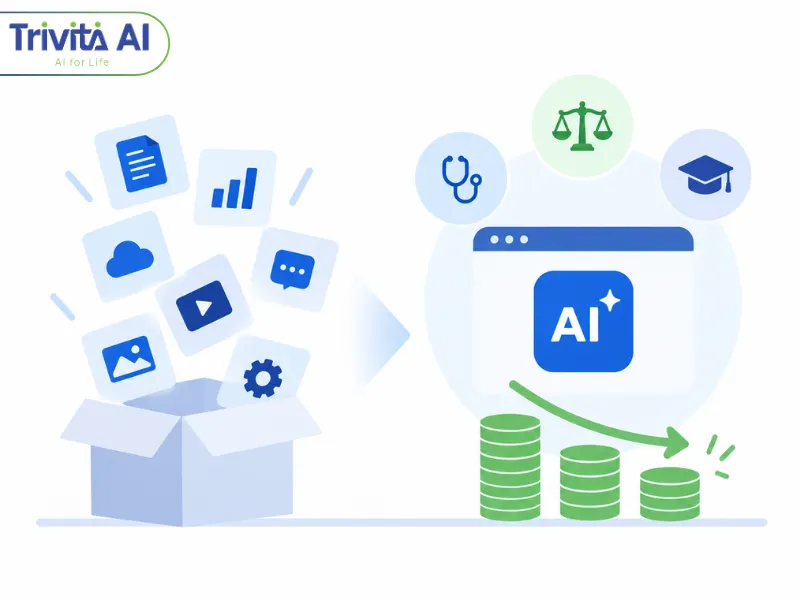
This direction is reflected in an ecosystem that includes MedVita for healthcare, which is currently being deployed; LawVita for legal services, which is under development; and EduVita as Trivita AI’s direction for education. Each domain has its own challenges, data and specialized knowledge, while developing on shared core AI capabilities helps prevent these branches from becoming completely isolated tools.
This combination of shared platform capabilities and specialization is intended to ensure that technology remains appropriate for each specific problem while allowing what has already been built to continue contributing to AI development across the broader ecosystem.
Optimizing AI costs starts with how enterprises build capabilities
An AI Platform for reducing costs should not be understood as a guarantee that deploying an AI Platform will automatically reduce total operating costs. Its value lies in organizing technology in a way that limits fragmented investment, enables appropriate capabilities to be reused and provides a foundation on which new applications can build.
When data, infrastructure and AI capabilities are organized as a shared foundation while individual solutions remain specialized for specific business requirements, enterprises are better positioned to manage complexity as AI adoption expands and direct investment toward problems that create meaningful value.
This is also how Trivita AI approaches industry-specific AI development, with technology serving as a foundational capability that supports people and evolves according to real-world requirements rather than being driven by the number of tools or features deployed.
