

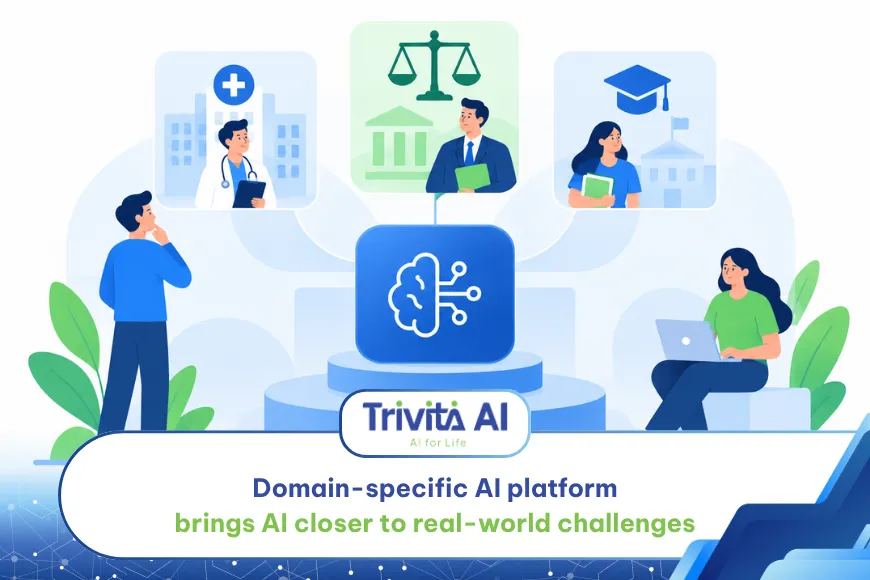
A domain-specific AI platform combines technology with industry data, knowledge and workflows to support more practical AI applications.
AI systems can support a wide range of tasks, from synthesizing information and analyzing data to assisting users with everyday activities. However, the fact that a technology can operate across multiple scenarios does not mean it is equally suitable for every domain.
Healthcare has its own language, data and professional workflows. The legal sector has a different knowledge system and operational logic. Education introduces distinct requirements related to learners, content and experiences. As AI technology becomes more deeply integrated into these environments, general information-processing capabilities are only the starting point.
This is why the domain-specific AI platform is becoming an increasingly important approach. Instead of applying the same tool across every industry, AI technology is developed around the context, data, knowledge and specific challenges of the domain it is designed to serve.
A domain-specific AI platform places technology in the right context
An AI Platform may include capabilities such as natural language processing, computer vision, machine learning and data analytics. However, when these capabilities are deployed in real-world environments, they need to operate within a specific context.
The same natural language processing capability will be used differently in healthcare and legal applications. A system supporting healthcare professionals needs to work with medical terminology and domain-specific data. In contrast, a system designed for the legal sector must operate within the relevant body of legal knowledge, documents and professional workflows.
Therefore, a domain-specific AI platform is not simply a general-purpose AI Platform rebranded for different industries. The difference lies in how the technology is developed and structured around the unique characteristics of its operating environment.
When AI systems better understand the context in which people work, the technology has a stronger foundation for providing relevant support rather than merely generating generalized outputs.
General-purpose AI cannot fully address domain-specific challenges
General-purpose AI tools provide significant advantages in terms of accessibility. Users can quickly use AI applications to ask questions, process text, summarize content or support a wide range of activities without building dedicated systems.
Limitations begin to emerge when requirements move from general tasks to specialized professional workflows.
A natural-sounding answer is not necessarily appropriate within a professional context. A result generated quickly may not be suitable for direct integration into real-world workflows. Similarly, the ability to process large volumes of information does not mean an AI system understands how an organization’s data is created, structured and used.
These differences become particularly significant in domains with specialized knowledge systems, workflows and professional standards. In such environments, enterprises and organizations need more than a capable AI model. They need a domain-specific AI platform that can adapt to the environment in which professionals actually work.
This does not diminish the value of general-purpose AI. The two approaches address different levels of requirements. General-purpose tools are suitable for many common tasks, while specialized AI becomes increasingly necessary when technology needs to participate more deeply in specific industry use cases.
Domain-specific data creates the foundation for AI adaptability
Data is one of the key factors that differentiates one domain from another. The differences extend beyond the content itself to how data is created, organized, accessed and used within each operational environment.
In healthcare, data is connected to specialized clinical workflows and professional requirements. In the legal sector, information exists within systems of legal documents and knowledge. In education, data relates to content, learners, learning processes and various other contexts of use.
A domain-specific AI platform therefore needs to be developed in relation to the data environment in which it will operate. AI systems should not simply be capable of receiving data; they should also be designed to use that data appropriately according to specific objectives and contexts.
This also explains why a solution that performs well in one domain cannot necessarily be transferred unchanged to another. Core technological capabilities may be reused, but the way data is connected and utilized needs to adapt to each industry.
Domain knowledge helps AI move from knowing more to understanding the right context
Access to large volumes of information makes AI technology powerful, but in professional environments, having access to more information is not the only condition for creating value.
Professionals do more than use information. They understand terminology, relationships between facts, business processes and the conditions that determine how information should be interpreted and applied. This is the contextual layer that a specialized AI Platform needs to address.
For example, the same term may carry a highly specific meaning within a particular domain. A piece of information may be correct in isolation but require a different interpretation when placed within a professional workflow. Domain-specific AI therefore needs to be developed through the combination of technological capabilities and specialized knowledge.
The role of domain experts also becomes critical in this process. AI systems do not replace human expertise. Instead, they should be developed with human involvement so that the technology can better understand the professional environment it is intended to support.
Real-world workflows determine where AI should be applied
A domain-specific AI platform creates meaningful value only when it is positioned appropriately within real-world workflows. Not every step requires AI technology, and not every task that can be automated should be handed over entirely to an AI system.
A more effective starting point is to identify the challenges people encounter in their daily work. These may include large volumes of information that need to be processed, time-consuming access to knowledge or repetitive tasks that create additional workload for users.
The role of AI technology can then be defined around these problems. AI systems can support information processing, organize data or help users access knowledge more efficiently, while people retain professional responsibility and make the decisions that require human judgment.
This approach helps organizations avoid introducing AI into workflows simply because the technology is capable of performing a particular task. The objective is not to use as much AI as possible, but to apply AI where it creates meaningful value for people.
A domain-specific AI platform should be developed around industry standards
Industries differ not only in their data and knowledge but also in the regulations, standards and levels of risk associated with technology adoption.
This becomes particularly important in environments involving sensitive data or decisions that directly affect people. As AI systems become more deeply involved, factors such as data security, risk management, testing and validation need to become integral parts of platform development.
Therefore, domain-specific AI should not simply be understood as training technology on larger volumes of industry data. A domain-specific AI platform must also adapt to how the industry operates and to the principles and standards professionals are required to follow.
This is one of the key differences between using an off-the-shelf AI tool and developing a platform capable of participating more deeply in real-world operations.
Trivita AI develops AI from the specific challenges of each domain
Trivita AI focuses on developing specialized AI Platforms for individual industries. Rather than treating a general-purpose AI model as a solution that can be applied unchanged across every domain, Trivita AI begins with domain-specific problems, data, specialized knowledge, regulations and relevant professional standards.
The development process starts with understanding the industry and analyzing the problem before building the AI Platform, deploying the solution in real-world environments and continuing to improve it according to actual user requirements. This places technology in direct relationship with the environment it is designed to serve.
This approach also requires the integration of multiple areas of expertise. Alongside scientists and AI engineers, domain experts play an important role in connecting technology with specialized knowledge and professional practice. Capabilities in natural language processing, computer vision, machine learning, data and AI infrastructure are developed alongside testing, validation, data security and risk management.
The objective is not to develop AI systems that replace people within each industry, but to build technology that works alongside professionals and helps them perform their work more effectively.
The Trivita AI ecosystem connects shared capabilities with specialized domains
Building on its core AI capabilities, Trivita AI is developing an ecosystem based on a shared technological foundation and multiple specialized branches. Each branch can leverage common platform capabilities while being developed according to the data, workflows and professional characteristics of its respective domain.
MedVita brings AI capabilities into healthcare environments
MedVita is Trivita AI’s healthcare-focused AI branch and is currently being deployed. Healthcare clearly demonstrates the need for a domain-specific AI platform, as technology must operate in relation to specialized data, professional knowledge, clinical workflows and security requirements.
Under Trivita AI’s approach, healthcare AI technology is designed to support rather than replace doctors or healthcare professionals. AI systems are intended to work alongside people in processing information and performing tasks according to the specific context in which they are used.
VitaLaw brings AI closer to legal knowledge
VitaLaw is Trivita AI’s AI branch for the legal sector and is currently under development. The legal domain has its own terminology, documentation systems and professional logic, meaning that general natural language processing capabilities alone are not sufficient to create a specialized solution.
VitaLaw demonstrates how core AI capabilities can be developed further based on the knowledge and operating environment of a specific domain. People continue to retain professional responsibility, while AI technology is positioned as a tool for more efficient access to and processing of legal knowledge.
EdVita extends domain-specific AI into education
EdVita represents Trivita AI’s direction for the education sector. Unlike healthcare and legal services, education has its own users, content, objectives and experience requirements.
AI applications in education therefore need to begin with the characteristics of learners and educational environments rather than directly adopting a design created for another industry. AI technology is intended to help people access knowledge and support more relevant learning experiences without replacing the role of teachers or learners.
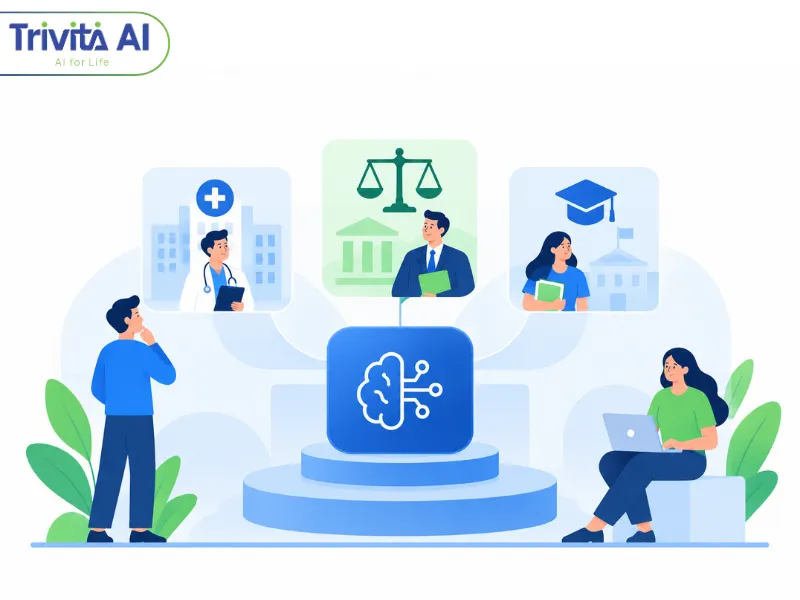
These three branches demonstrate how a shared core technology platform can evolve into different specialized capabilities. What connects them is not that they all use the same tool, but that core AI capabilities are adapted to each real-world environment.
Domain-specific AI Platforms support long-term AI capabilities
Specializing AI does not mean that every industry needs to build every technological component from the ground up. The value lies in the ability to leverage core AI capabilities and develop them according to the data, knowledge, workflows and specific requirements of each domain.
This approach offers an alternative to using standalone AI tools. Instead of solving individual tasks in isolation, a domain-specific AI platform can become part of an organization’s long-term technology capabilities.
At this level, the important question is no longer how many tasks AI can perform. Enterprises and organizations need to determine how well AI systems understand their operating environment, whether they align with existing data and workflows, how the technology is validated and what role people retain when AI becomes part of their work.
Trivita AI develops domain-specific AI with people at the center
A domain-specific AI platform represents an approach in which AI requires more than technological capabilities. It must operate in relation to the data, knowledge, workflows and standards of the environment it is designed to serve.
Based on this direction, Trivita AI is developing an ecosystem that includes MedVita for healthcare, VitaLaw for the legal sector and EdVita for education. Each platform builds on shared core AI capabilities while adapting to the specific characteristics of its respective domain.
Regardless of how specialized the technology becomes, people remain central to Trivita AI’s approach to AI development. The ultimate objective is not to introduce AI into as many tasks as possible, but to help people access knowledge more effectively, work more efficiently and gain better tools to support informed decisions in real-world environments.
