

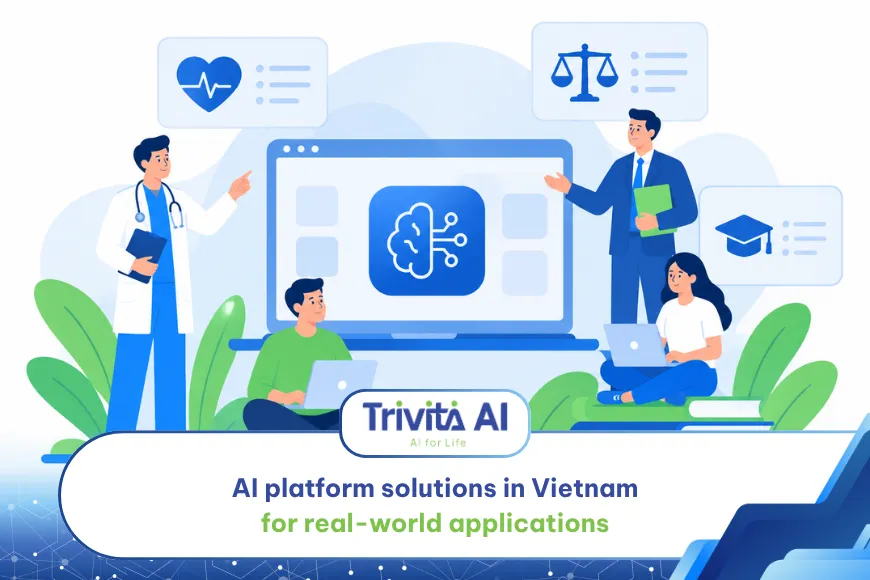
AI platform solutions in Vietnam connect technology with data, workflows and industry knowledge to support practical and sustainable AI adoption.
AI is gradually evolving from standalone tools into platforms capable of playing a deeper role in organizational and enterprise operations. As AI adoption becomes increasingly focused on specific use cases, the key question is no longer whether organizations should use AI, but which technologies can effectively work with the data, workflows and domain-specific requirements of each industry.
This is also why AI platform solutions in Vietnam should be viewed as more than tools capable of generating content, answering questions or automating individual tasks. The value of an AI Platform lies in its ability to place AI technology within the right context, connect technology with people and support the resolution of real-world challenges.
AI platform solutions in Vietnam connect technology with real-world challenges
An AI Platform in Vietnam may include multiple components such as AI models, data, technology infrastructure and user-facing applications. However, bringing multiple technologies together within a single system is not enough to create a valuable platform.
What matters is the platform’s ability to connect these technological capabilities with specific problems. AI systems need to understand what data is being used, where users need support, how workflows operate and what domain-specific requirements must be addressed.
For example, an AI model with strong natural language processing capabilities is not automatically ready to meet the requirements of healthcare or legal applications. Each industry has its own terminology, knowledge, data and workflows. As AI technology moves deeper into real-world applications, these differences directly influence how an AI Platform should be designed.
Therefore, the value of AI platform solutions in Vietnam should not be evaluated solely by the number of features they provide. The ability to adapt to the actual context of use is what determines whether AI technology can move from experimentation to practical deployment.

Enterprise AI Platforms need to go beyond standalone AI tools
General-purpose AI tools can effectively support independent tasks such as summarizing documents, retrieving information or handling routine activities. However, as AI systems become more deeply integrated into enterprise operations, the requirements become more complex.
The first consideration is data. Every organization has its own data environment, which may include internal documents, management software, databases and multiple other sources. Data structures, quality and usage patterns also vary significantly. An Enterprise AI Platform therefore needs to operate effectively within the organization’s actual data environment rather than relying solely on general information sources.
Business workflows represent another critical consideration. A platform designed for hospitals does not address the same challenges as one built for legal enterprises or educational organizations. Even companies operating within the same industry may have different processes, resources and AI adoption objectives.
Domain knowledge introduces another layer of complexity. Healthcare, legal services and education each have their own terminology, professional logic and standards. When an AI system does not adequately understand this context, an answer that appears linguistically reasonable may still be unsuitable for supporting real-world professional work.
This creates the foundation for AI solutions in Vietnam to become increasingly specialized. Rather than attempting to build one general-purpose tool for every problem, AI Platforms should be designed around the environments in which people actually use the technology.
5 factors that define an AI Platform suitable for enterprises
Selecting an AI Platform should not begin by comparing which solution offers the greatest number of features. A more effective approach is to evaluate the relationship between the technology and the specific business problem the organization needs to solve.
Real-world problems should be the starting point
Before selecting an AI model or technology, organizations need to identify the problem they are trying to solve, the users who will directly interact with the system, the bottlenecks within existing workflows and the areas where AI technology can provide meaningful support.
This approach helps organizations avoid implementing AI simply because the technology is attracting attention. When the underlying problem has not been clearly defined, adding more features or new AI models does not necessarily create additional value for users.
An AI Platform company in Vietnam therefore needs more than technological capabilities. It also needs the ability to understand business problems and translate them into challenges that can be effectively addressed through AI technology.
Adaptability to enterprise data determines practical value
Data is a fundamental component of AI systems, but every enterprise operates within a different data environment. An AI Platform should therefore be evaluated in relation to the organization’s existing data structures, data management practices and ability to adapt as data sources evolve.
This becomes particularly important when AI moves from experimentation into real-world operations. A system that performs well with sample data may not necessarily deliver the same value when working with an organization’s actual data and business processes.
Therefore, when evaluating AI platform solutions in Vietnam, enterprises should look beyond the capabilities of individual AI models and consider the entire environment in which the platform will operate.
Domain knowledge gives AI greater depth
AI systems can process large volumes of information, but every industry has its own body of specialized knowledge. The ability to understand and operate within that knowledge environment directly affects the practical value of AI applications.
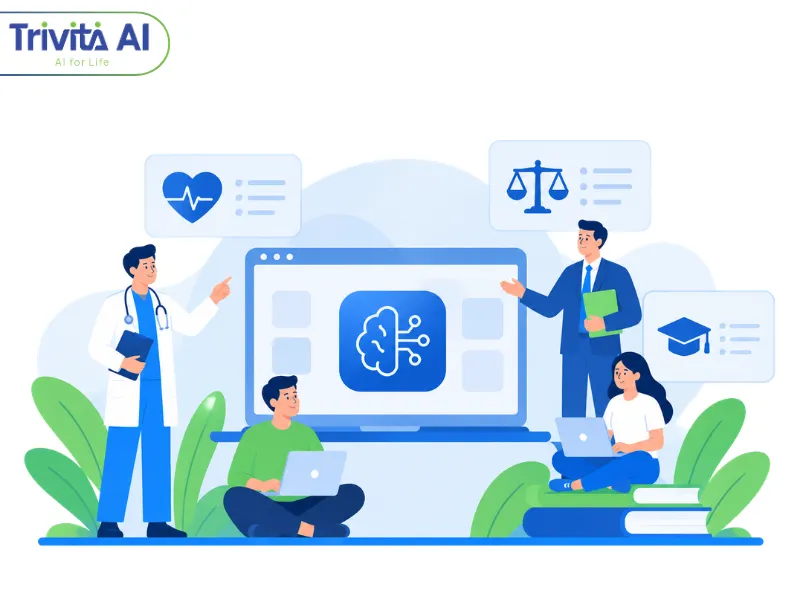
In healthcare, technology must work alongside clinical data, medical terminology, professional workflows and industry-specific requirements. In the legal sector, AI systems need to work with the structure and application of legal knowledge. In education, AI applications serve different users, methods and objectives.
Specialization, therefore, is not simply a matter of adding industry data to an AI model. It involves placing technology within the correct professional context so that the platform can provide more relevant and effective support to people.
Security and responsibility should be built into the design
As AI becomes more deeply involved in organizational operations, speed and convenience cannot be the only criteria. How data is used, how risks are controlled and how responsibility is managed throughout system operation should be considered from the beginning of the solution design process.
These requirements become even more important in industries involving sensitive data or strict professional standards. An Enterprise AI Platform should therefore be developed with an approach that balances technological capabilities with responsibility in real-world deployment.
Long-term partnership determines sustainable value
AI adoption does not end when a system is deployed. Data can change, workflows can evolve and user requirements will continue to develop.
An AI Platform therefore needs to support ongoing experimentation, evaluation and improvement based on real operational conditions. When selecting a provider of AI solutions in Vietnam, enterprises should consider not only the provider’s ability to build the initial system but also its capacity to support implementation and long-term solution development.
How Trivita AI builds industry-specific AI Platforms
Trivita AI focuses on developing specialized AI solutions rather than treating a single general-purpose model as the answer to every industry challenge. This approach begins with industry-specific problems, data, domain knowledge, regulations and relevant professional standards.
The development process is structured around understanding the industry, analyzing the problem, building the AI Platform, deploying it in real-world environments and continuously improving the solution based on actual user requirements. This allows technology to become integrated with people and workflows rather than operating separately from them, helping users access knowledge, perform tasks and make better-informed decisions.
To support this approach, Trivita AI combines the expertise of scientists, AI engineers and industry specialists with technological capabilities in natural language processing, computer vision, machine learning, data and AI infrastructure. The development process also emphasizes experimentation, validation, data security, risk management and responsibility in AI adoption.
The Trivita AI ecosystem evolves from shared technology to specialized capabilities
Trivita AI’s development strategy is based on a shared core technology foundation combined with multiple specialized capabilities. Rather than building disconnected AI tools, each branch of the ecosystem inherits common technological capabilities while being designed around the data, workflows, knowledge and standards of its respective industry.
MedVita brings AI technology into real-world healthcare applications
MedVita is Trivita AI’s healthcare-focused AI branch and is currently being deployed. The platform addresses practical healthcare challenges in an environment where data, professional workflows, security requirements and responsible technology use involve highly specialized considerations.
Within this approach, AI systems are not positioned as replacements for doctors or healthcare professionals. Instead, the technology supports people in accessing and processing information more efficiently while being developed in alignment with the practical requirements of healthcare environments.
VitaLaw develops AI around the characteristics of legal knowledge
VitaLaw is Trivita AI’s specialized AI branch for the legal sector and is currently under development. It also illustrates why an AI Platform needs to go beyond general natural language processing capabilities.
Legal knowledge systems, terminology and professional logic create specific requirements for how AI technology should be designed and applied. VitaLaw therefore places technology within the appropriate professional context rather than treating general-purpose AI as a solution that can be applied to the legal sector without adaptation.
EdVita focuses on AI applications in education
EdVita represents Trivita AI’s direction for the education sector. In this field, AI technology is positioned as a tool that helps people access knowledge and supports more relevant learning experiences rather than replacing the role of teachers or learners.
MedVita, VitaLaw and EdVita are therefore not three independent AI tools. They are specialized branches within the broader Trivita AI ecosystem, sharing core technological capabilities while being developed according to the specific characteristics of each industry.
The value of an AI Platform lies in its long-term application capabilities
When organizations first approach AI at the tool level, value is often measured by how quickly a specific task can be completed. However, as enterprises move toward deeper AI adoption, the focus needs to shift from using individual tools to building AI capabilities that can support long-term operations.
At this level, AI platform solutions in Vietnam are not simply about generating answers or automating individual tasks. The platform needs to connect technology with enterprise data, knowledge and workflows to support people across an integrated operational environment.
This shift also changes how enterprises should evaluate AI solutions. Rather than focusing solely on the number of features a platform provides, organizations need to consider how well the platform understands their business challenges, how effectively it works with enterprise data, how the technology is validated and what role people retain throughout the AI adoption process.
Trivita AI develops AI Platforms that work alongside people
AI platform solutions in Vietnam create meaningful value when technology is applied to the right human and business challenges and can work effectively with enterprise data, workflows and domain knowledge rather than operating as an isolated tool.
Through its industry-specific AI strategy, Trivita AI connects research and technological capabilities with the unique requirements of different sectors through the MedVita, VitaLaw and EdVita ecosystem. Across these platforms, AI technology is designed to support people in accessing knowledge, performing their work and making better-informed decisions.
For enterprises and organizations considering AI adoption, the most effective starting point is not necessarily selecting a technology immediately. Instead, organizations should first identify the right business problem, understand the data they already have and determine the role AI technology can realistically play. From there, they can develop an AI adoption strategy that can be validated, adapted and expanded according to real-world operational requirements.
