

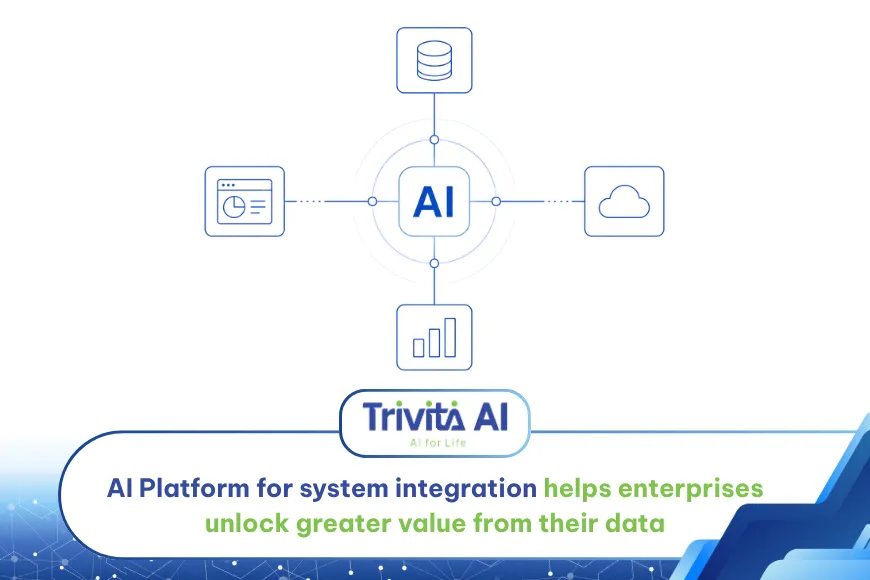
Learn how an AI Platform for system integration connects ERP, CRM and other enterprise systems through a unified platform, enabling seamless data sharing and more efficient operations.
Most organizations today have invested in multiple enterprise systems to support specialized business functions, including ERP, CRM, HRM, accounting software, document management systems and other operational applications. While each platform performs its own function effectively, enterprise data often remains scattered across multiple systems, making it difficult to utilize consistently.
When business systems cannot exchange information efficiently, organizations face fragmented data, disconnected workflows and AI systems that lack sufficient business context to support decision-making. This is why more enterprises are recognizing the importance of AI Platform capabilities for system integration.
What is an AI Platform for system integration?
An AI Platform for system integration serves as an intermediary layer that connects enterprise data sources, business applications and AI models. Rather than operating independently, the AI Platform enables existing systems to work together by facilitating data sharing and standardizing business processes.
It is important to understand that an AI Platform does not replace ERP, CRM or other enterprise applications. Each system continues performing its specialized business functions, while the AI Platform leverages data from multiple sources to support information retrieval, analytics, automation and more effective decision-making.
Within enterprise environments, an Enterprise AI Platform refers to an AI platform capable of integrating with existing IT infrastructure, centrally managing enterprise data and supporting multiple AI use cases across the organization. This allows AI to become an integral part of business operations instead of remaining a collection of isolated tools.
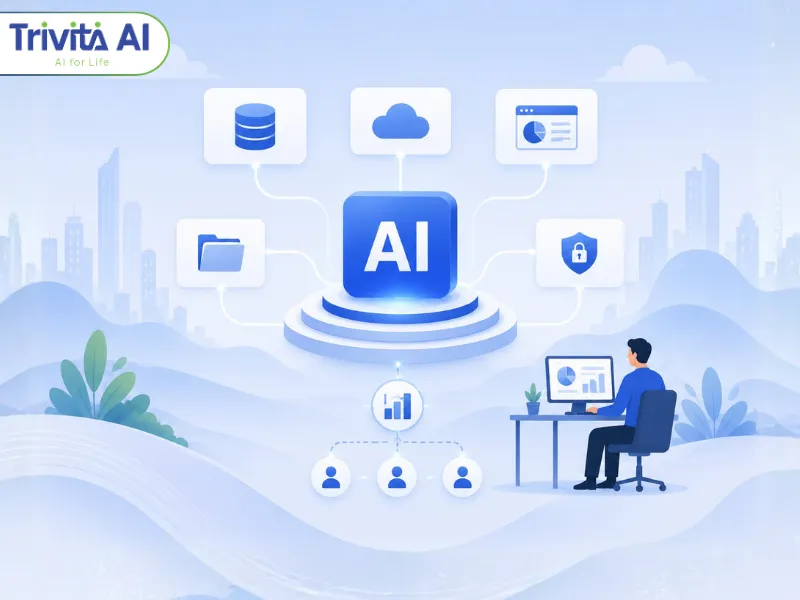
Which enterprise systems can an AI Platform integrate with?
AI Platform integration with ERP
ERP systems contain critical business data related to finance, manufacturing, supply chain operations and enterprise management. When an AI Platform integrates with ERP, organizations can leverage this information to analyze business performance, optimize operational processes and provide managers with faster access to business insights.
ERP integration also enables AI to better understand the operational context of the organization instead of processing isolated tasks independently.
AI Platform integration with CRM
CRM systems store customer information, sales history and customer relationship data. When integrated with CRM, an AI Platform enables organizations to leverage customer information for demand analysis, customer experience improvement, service optimization and more effective sales support.
This enables customer-related decisions to be driven by comprehensive data rather than intuition alone.
Integration with HRM and human resource systems
Beyond ERP and CRM, an AI Platform can integrate with HRM systems to support workforce management, employee training, enterprise knowledge management and internal operations.
When HR data is connected with other enterprise information sources, organizations can create more efficient workflows while enabling employees to access relevant documentation and operational guidance directly within their daily work.
Connecting documents and other enterprise data sources
In practice, enterprise data extends beyond business applications. Valuable information also exists within email systems, document repositories, databases, project management platforms and numerous internal applications.
A modern AI Platform should be capable of integrating with multiple enterprise data sources to create a unified information ecosystem. This enables organizations to expand AI adoption without being constrained by individual software applications.
Why is connected enterprise data essential for AI?
AI creates value only when it has complete data
The quality of AI outcomes depends heavily on the information available to the platform. If enterprise data is isolated across multiple systems or remains incomplete, AI can generate insights based only on partial information.
When an AI Platform enables seamless data integration, AI gains broader business context, allowing it to deliver more accurate information retrieval, analytics and recommendations that better reflect organizational operations.
Reducing enterprise data silos
Many organizations possess enormous amounts of valuable data but struggle to utilize it because information remains scattered across multiple platforms. As a result, employees spend excessive time searching for information or repeatedly entering the same data.
An AI Platform reduces data silos by connecting existing enterprise systems, enabling information to flow more efficiently throughout the organization.
Connecting business workflows
Most business processes involve multiple departments and software systems. If information cannot move seamlessly between these systems, operational workflows become fragmented and business efficiency declines.
When an AI Platform connects enterprise systems, information flows continuously across departments, reducing manual work while improving collaboration throughout the organization.
Supporting future AI expansion
Organizations rarely deploy only a single AI application. As business requirements evolve, enterprises inevitably expand into additional AI use cases.
A well-integrated AI Platform allows organizations to leverage existing enterprise data and technology infrastructure when deploying future AI initiatives without rebuilding the underlying architecture. This significantly reduces implementation costs while accelerating future AI adoption.
What should organizations consider when selecting an AI Platform for system integration?
Compatibility with existing IT infrastructure
Every organization has its own technology environment. Therefore, an AI Platform should integrate flexibly with existing enterprise systems instead of requiring organizations to replace their current infrastructure.
Enterprise security and data access management
As more business systems become interconnected, controlling data access and maintaining security become increasingly important. Organizations should prioritize AI Platforms that provide robust access controls, role-based permissions and comprehensive data governance capabilities.
Future scalability
Enterprise AI requirements evolve as organizations grow. A suitable AI Platform should support future expansion by integrating additional systems, new data sources and emerging AI use cases without disrupting existing business operations.
Centralized enterprise management
Beyond system integration, organizations should prioritize platforms that provide centralized management of users, enterprise data, AI applications and business workflows through a unified administrative interface.
This simplifies governance, reduces administrative complexity and establishes a scalable foundation for long-term AI adoption.
System integration is the foundation for long-term AI value
AI cannot deliver its full potential if it operates separately from the enterprise systems that drive daily business operations. The true value of AI comes not only from sophisticated algorithms but also from its ability to connect enterprise data, business processes and applications into a seamless flow of information.
An AI Platform for system integration enables organizations to maximize the value of their existing IT investments instead of replacing established systems, while providing a scalable foundation for future AI initiatives.
If your organization is evaluating how to integrate AI with its existing enterprise architecture, Trivita AI can help assess your current technology environment and develop an AI Platform tailored to your operational objectives and long-term business strategy.
